


When done right, a business or freelancer using AI can bring in a thousand dollars every month (if not much more), and you’d be amazed at how little it costs to keep the wheels turning. We’ve put our minds together to bring you the best ways of making money with AI, and the tools each one runs on. We’ve curated legitimate business and side gig opportunities for you to explore.
There is no AI tool where you log in and money lands in your bank account. AI can make a capable person dramatically more productive, and AI agents carry out multi-step tasks on their own. When you look at ways to make money using AI, focus on applications that save time, sharpen your skills, reduce costs, and let you take on work you couldn’t do alone.
The list runs roughly best-first: highest earning potential, strongest current demand, and most durable. The last one on the list is the one you could start this week with no clients at all.
-
1
10 Ways To Make Money With AI
- 1.1 1. Build And Sell AI Agents & Automations
- 1.2 2. Offer AI Consulting And Fractional Work
- 1.3 3. Start A Web Design Business
- 1.4 4. Build Apps With AI
- 1.5 5. Manage Paid Advertising With AI
- 1.6 6. Offer SEO And AEO Services
- 1.7 7. Run YouTube Channels With AI
- 1.8 8. Offer Writing Services With AI
- 1.9 9. Run An Affiliate Site With AI Doing The Grunt Work
- 1.10 10. Get Paid To Train And Evaluate AI
- 2 What Probably Won’t Work (For 99% Of People)
- 3 AI Is A Tool, Not A Get-Rich-Quick Hack
- 4 How Will You Decide To Make Money Using AI?
10 Ways To Make Money With AI
We’ve got 10 ideas that can help you earn money with AI. Each of them requires access to an AI tool and some strategic thinking. But each is accessible for those looking to make honest money online using AI. Even if you don’t build a business or side hustle out of these, you can still improve your productivity by learning how to use AI.
1. Build And Sell AI Agents & Automations
If chatbots answer questions, agents get work done. This is the fastest-growing corner of the AI economy, which is why it leads the list. Businesses don’t want something to chat with. They want AI that triages their inbox, updates their CRM, drafts and schedules content, processes invoices and documents, and hands off to a human only when it needs to. Most owners can see the value but have no idea how to wire it up, and that is what you sell.
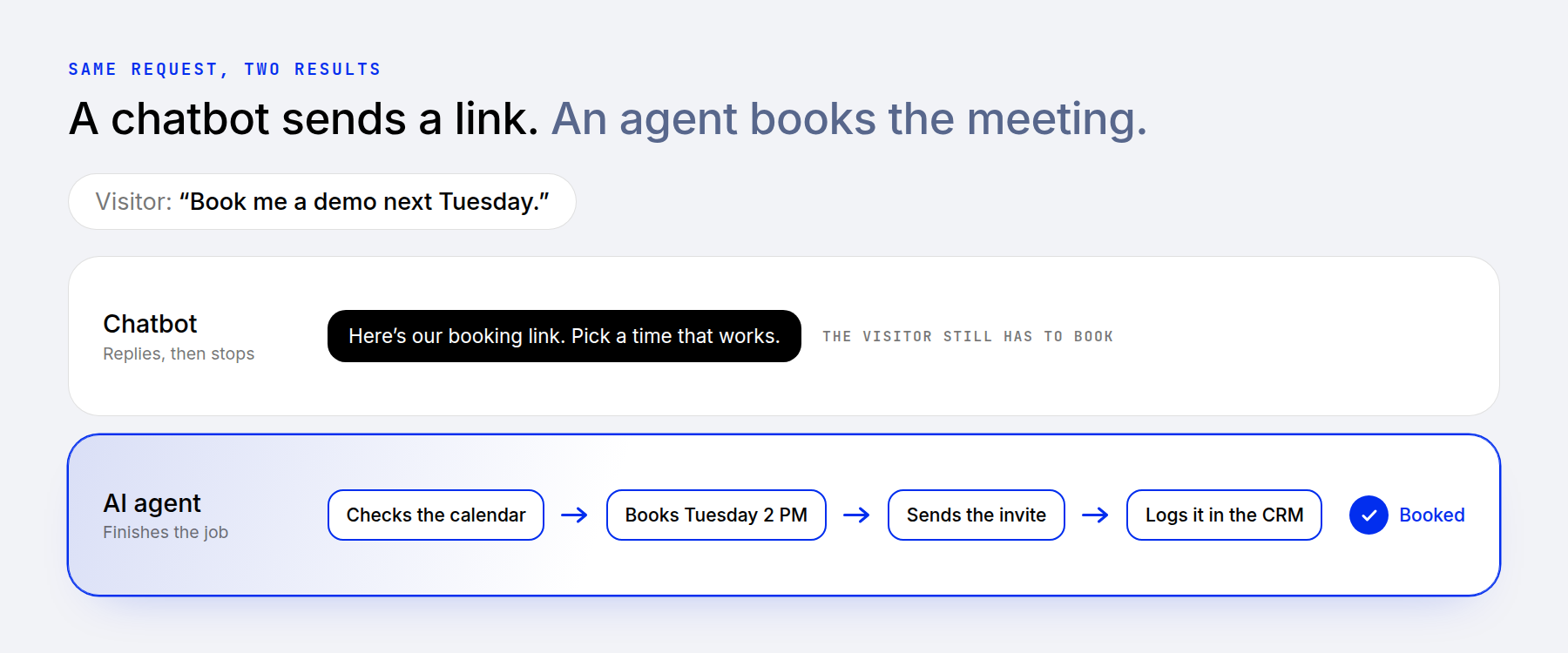
Take a situation where a business owner wants to perfect their lead generation from their site. A visitor asks to book a demo. A chatbot replies with a booking link, and maybe that is it. But an agent checks the calendar, books the slot, sends the invite, and logs it in the CRM.
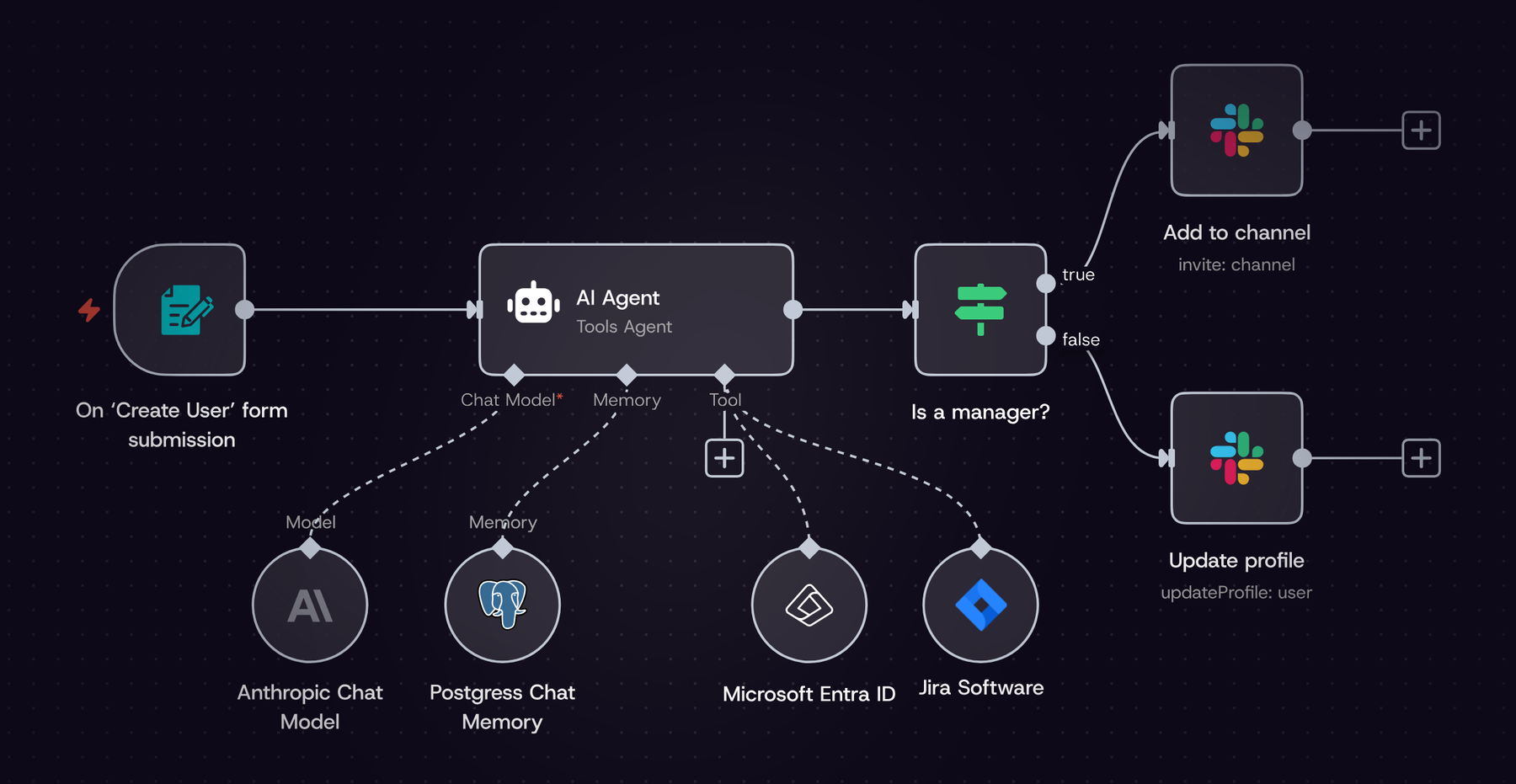
You can build these systems in a few ways. Automation platforms like Make, n8n, and Zapier include AI steps, so you can chain apps together with an LLM, making decisions in the middle. The standard behind a lot of this is the Model Context Protocol (MCP), which lets AI agents plug into a company’s real tools and data. In the n8n workflow below, a form submission feeds an AI agent step that has a chat model, memory, and tools attached, and the result routes to one of two Slack actions.
The play is the same as the other services on this list. Pick a platform (or a set of platforms to connect), get good at it, and sell done-for-you agents and automations, ideally on a monthly retainer so you’re paid to maintain and improve them. Start with something small and painful, like a report compiled by hand every week or a lead that takes an hour to qualify, and automate that one thing well.
Start With A Grounded Website Assistant
The easiest version of this work to sell is still the website assistant, and it’s a fine way in. Grounded in a company’s own documents, they answer accurately at any hour, guide people through troubleshooting, and help with sales and bookings, which lets your client spend their time on the cases that need a person.
Look into Chatbase and DocsBot.ai, as both are flexible enough to build several services around. Don’t stop at the answer. The money is in what happens after it.
Wire It Into The CRM They Already Pay For
Most businesses run a CRM at a fraction of its capacity, and plenty run one full of messy, unusable data. Whether they use it for ecommerce, sales, or email marketing, they need help with a tricky piece of software, and most major CRMs ship their own AI copilots that someone has to set up and steer.
Pick a single CRM to specialize in and one AI integration to pair with it, and you can offer a high-ticket service to businesses that need the technical acumen. Integration tools like ActivePieces and Make connect to the platforms a company already uses, and their AI steps add decision-making within workflows that only moved data from one app to another.
2. Offer AI Consulting And Fractional Work
Plenty of companies have already bought the licenses. Few of them have anyone who knows what to do with them. That gap is worth more than the software, and it’s the one thing on this list AI hasn’t commoditized, because what you’re selling is judgment.
Sell Decisions, Not Deliverables
Consulting here means answering the questions a business can’t answer for itself: what to automate first, what to leave alone, which tool fits the way they work, what it should cost, and how they’ll know if it worked. You are not handing over a deliverable so much as a decision, and good decisions are worth paying for precisely because a model can’t make them without the context it doesn’t have.
Go Fractional With A Handful Of Clients
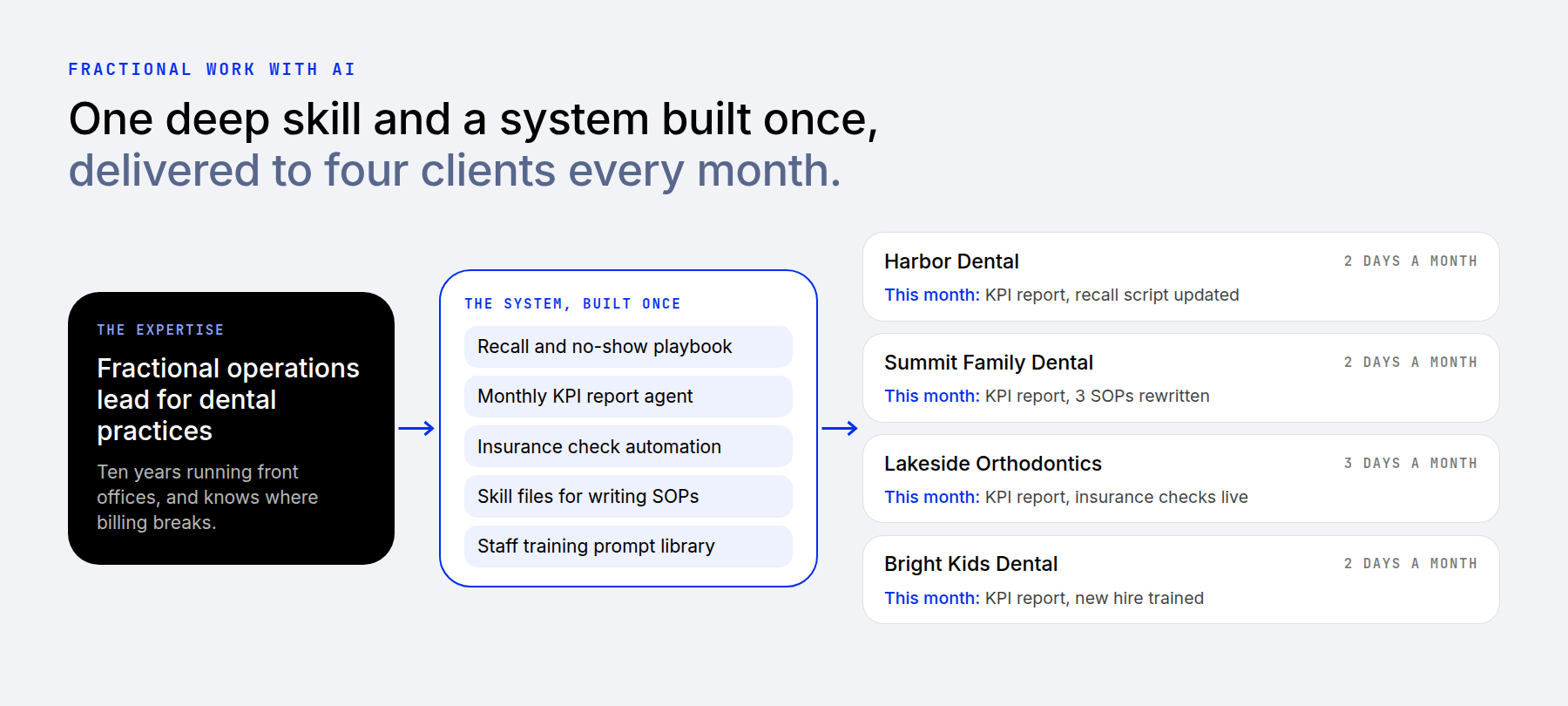
Fractional work is the same skill on a longer contract. Instead of a single engagement, you take a standing role with a handful of businesses for a few days each month as a fractional operations lead, marketing lead, or technical lead. This is where good systems pay off. If your own onboarding, documentation, reporting, and automations are sharp, you can carry several clients at once without drowning, and each one gets someone with more range than they could afford to hire outright.
Start By Training Their Team
Training is the easiest first sale. Most teams are using AI poorly and in private, with no shared prompts, no standards, and no idea what’s off-limits. A workshop, a written set of practices, and a small library of prompts built around their actual work make for a contained project with an obvious before-and-after. It also tends to lead directly into the bigger engagement, because you’ve spent a day learning where their processes break.
Sales and CRM strategy is a strong specialty within this, distinct from the build work in the last section. Someone has to decide which parts of a sales process should stay human, what the data hygiene rules are, and which AI features in their stack are worth turning on. Pick one industry rather than one tool. The consultant who knows how dental practices, law firms, or trucking companies operate will beat the generalist every time, because the hard part was never the software.
3. Start A Web Design Business
A website has long been required to establish a brand and drum up business, though the industry has been rocked by wave after wave of AI advancements. Still, companies need to build and maintain sites to succeed. A well-designed website attracts more visitors, keeps them around longer, and converts them into customers. That’s where professionals with the right tools can swoop in and solve a real need, and AI has made it possible to deliver far more site, far faster.
This is something we’re particularly passionate about. We’ve worked to create the best visual editing experience in WordPress. WordPress is so flexible that it can build a website for any need or niche, and Divi is a great theme builder to layer on top to make it as flexible for designers.
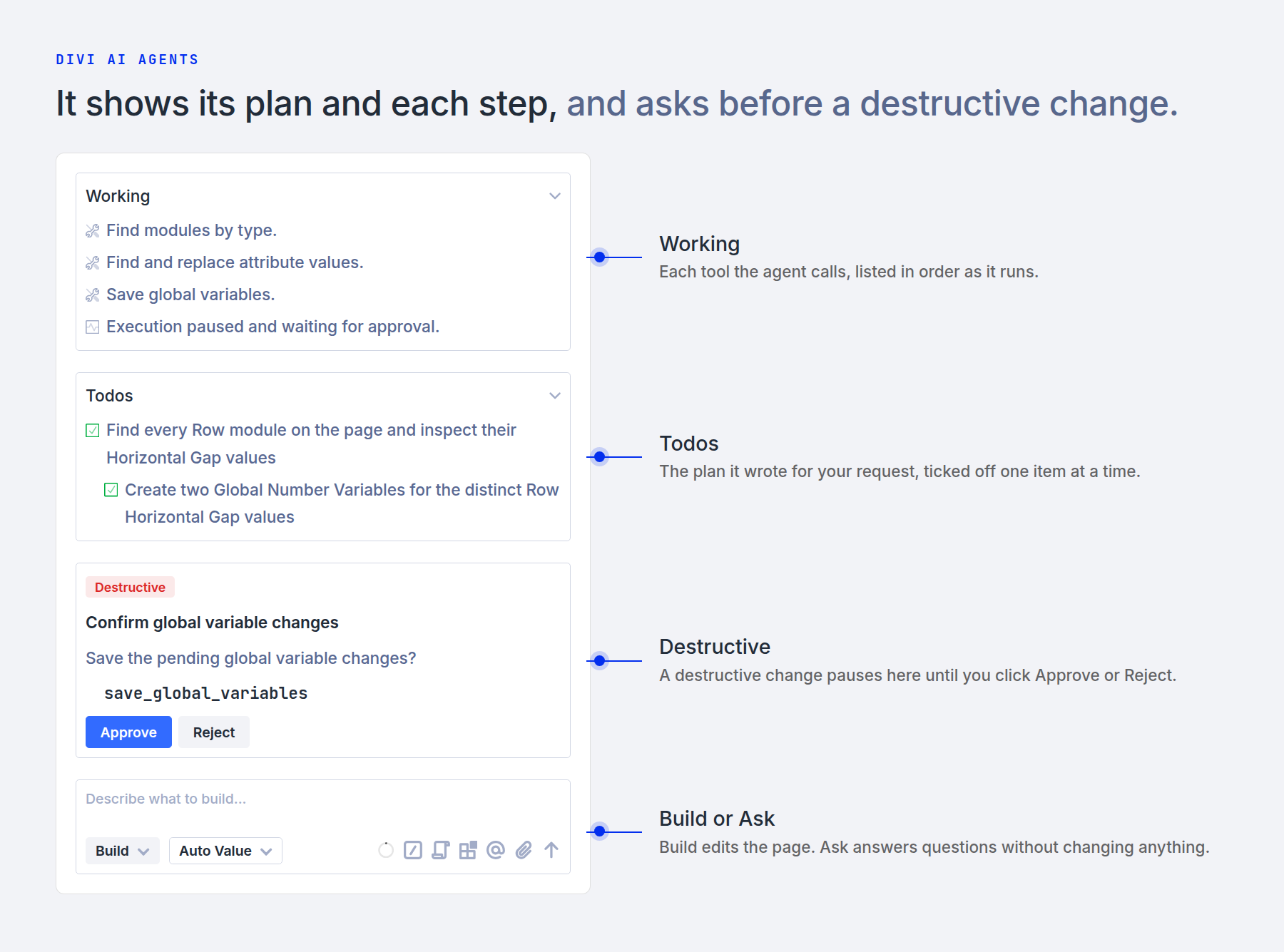
We recommend Divi AI Agents, the AI built into the Divi Visual Builder. Describe a page in plain language, and it plans the layout, adds the modules, writes the copy, and sets the styling while you watch each step land in the builder.
On a client site, you need control as much as speed. The agent writes its plan as a to-do list, shows every tool it calls, and pauses a destructive change until you approve it. Ask mode answers questions about a page without changing it, which is a safe way to audit a site you took over.
Even if traditional website design turns you off, there’s plenty of room (and growing) to get comfortable with AI-driven design. AI creates stunning layouts, writes landing-page copy, and generally takes some of the edge off building a site from scratch. There are many AI WordPress plugins and AI website builders that make building and managing sites easy.
Start with our guides on how to make a landing page with AI and how to create a money-making website.
4. Build Apps With AI
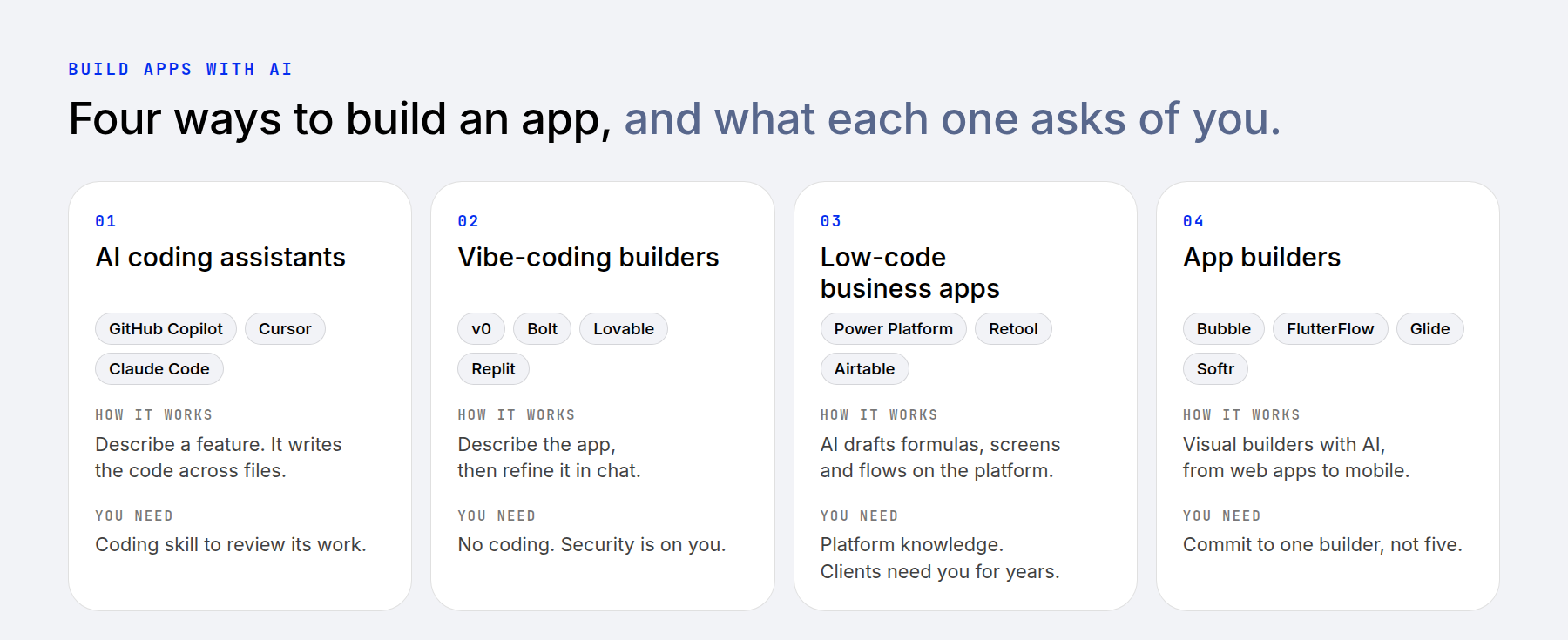
Building a software product means coming up with an idea, designing it, writing the code, testing it, and launching it. AI speeds up every step, and the work splits into four approaches, each requiring a different skill. Pick the one that matches what you already know.
Use AI Coding Assistants
AI coding tools like GitHub Copilot, Cursor, and Claude Code work as agents: describe a feature in plain English, and they’ll write it across multiple files, generate tests, and debug their own output while you review. You direct the build, and the AI writes the code.
All this means you can develop your product faster and with fewer obvious errors. Create an MVP (minimum viable product) and quickly start selling it to people who need what you’ve built. Keeping the initial product as simple as possible helps here, because tightly scoped projects are where these tools shine.
Need some inspiration? Indie developer Louis Pereira created AudioPen, an AI audio note-maker, which found real success as a small, focused app, exactly the kind of thing a solo builder can ship today.
Vibe-Code With No-Code AI Builders
You don’t need to be a developer to ship a working app. A class of AI builders that includes v0, Bolt, Lovable, and Replit’s agent lets you describe an app in plain language, watch it get built, and refine it by chatting. This is called “vibe coding.” You can lean on ChatGPT or Claude to answer technical questions as you go. If your app does one thing well, you can earn MRR (monthly recurring revenue) by growing a subscriber base for a low-cost tool they love.
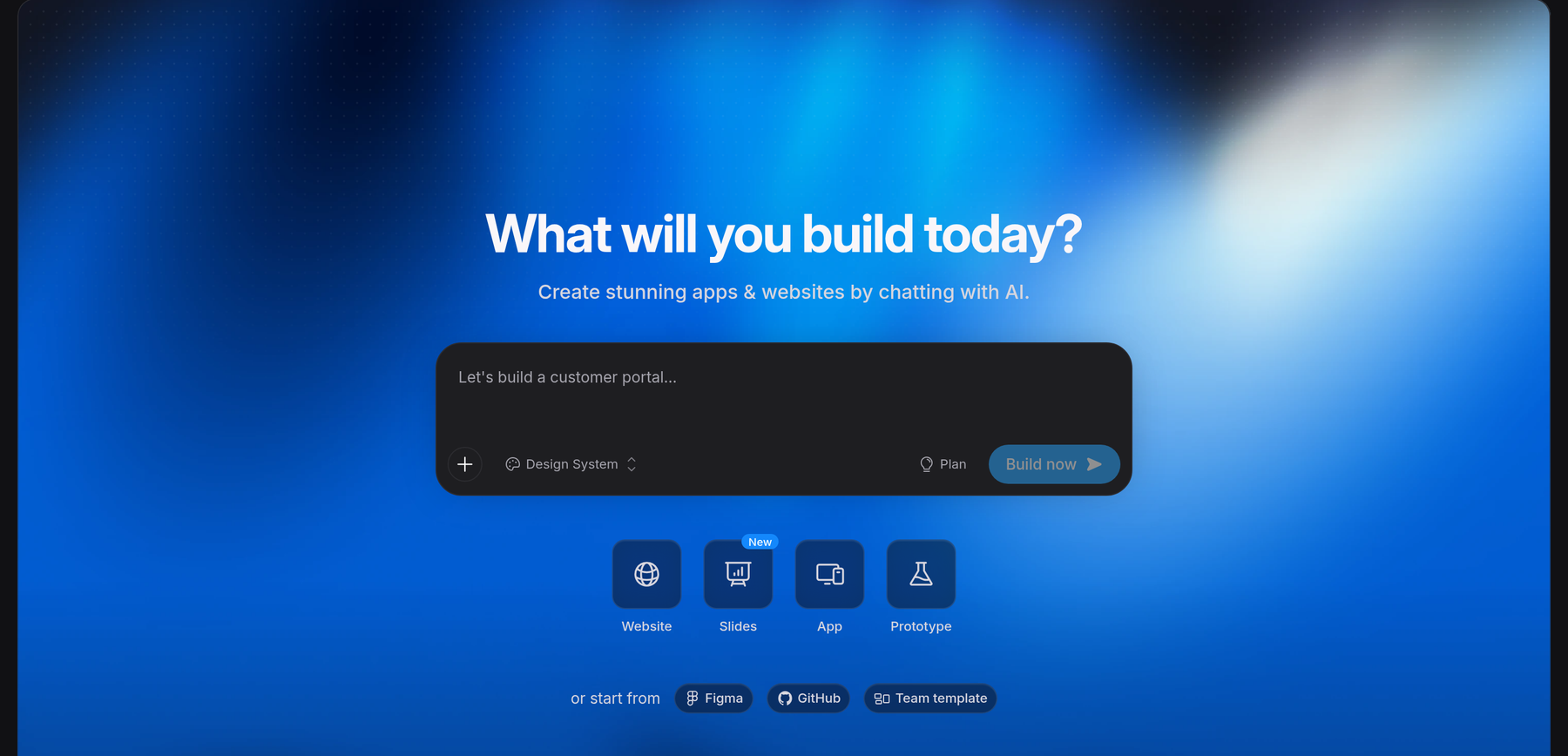
These tools are excellent at getting you to something that works. They are much weaker at everything after that: security, scale, and the unglamorous maintenance a paying product needs. Treat the generated app as a real first version rather than a finished one.
Build Business Apps On Low-Code Platforms
There’s a middle lane between vibe coding and traditional development, and it’s where a lot of the steady money is. Microsoft’s Power Platform covers Power Apps and Power Automate. It exists to build the internal business apps companies run on: inspection forms, approval workflows, asset tracking, and dispatch tools. The AI layer writes formulas, drafts screens, and builds flows, but the platform enforces enough structure that what you ship can survive contact with an IT department.
This work is less visible than consumer apps and considerably more durable. Companies that adopt a platform like this need someone for years, not weeks, and they’re accustomed to paying professional rates because the app runs a real part of the business. Similar opportunities exist with Retool for internal tools and Airtable for teams that have outgrown spreadsheets.
Among established app builders, Bubble remains the most capable for full web apps; FlutterFlow targets native mobile; and Glide and Softr get simple internal tools up and running quickly. All of them have added AI, and all of them reward someone who commits to one rather than dabbling in five.
Freelance Coding
Maybe you don’t have the time or passion to create your own AI app or startup, but you have a knack for coding. You might still put your skills and a bit of AI to good use by providing freelance services. Freelancing as a developer lets you pick the type of coding task to specialize in. A reliable way to increase your profits as a freelancer of any kind is to productize your skills.
As a coding freelancer, you can choose the tech stack you want to work with and the type of applications you want to help build. So you could develop with React for front-end web applications for small businesses that need to collect customer reviews on their websites (that’s one of millions of examples of niching down your offering).
After you do about five jobs, you’ll start to get fast at creating these solutions. You might even be able to package it as a plugin or extension that’s easier to implement on your clients’ websites.
5. Manage Paid Advertising With AI
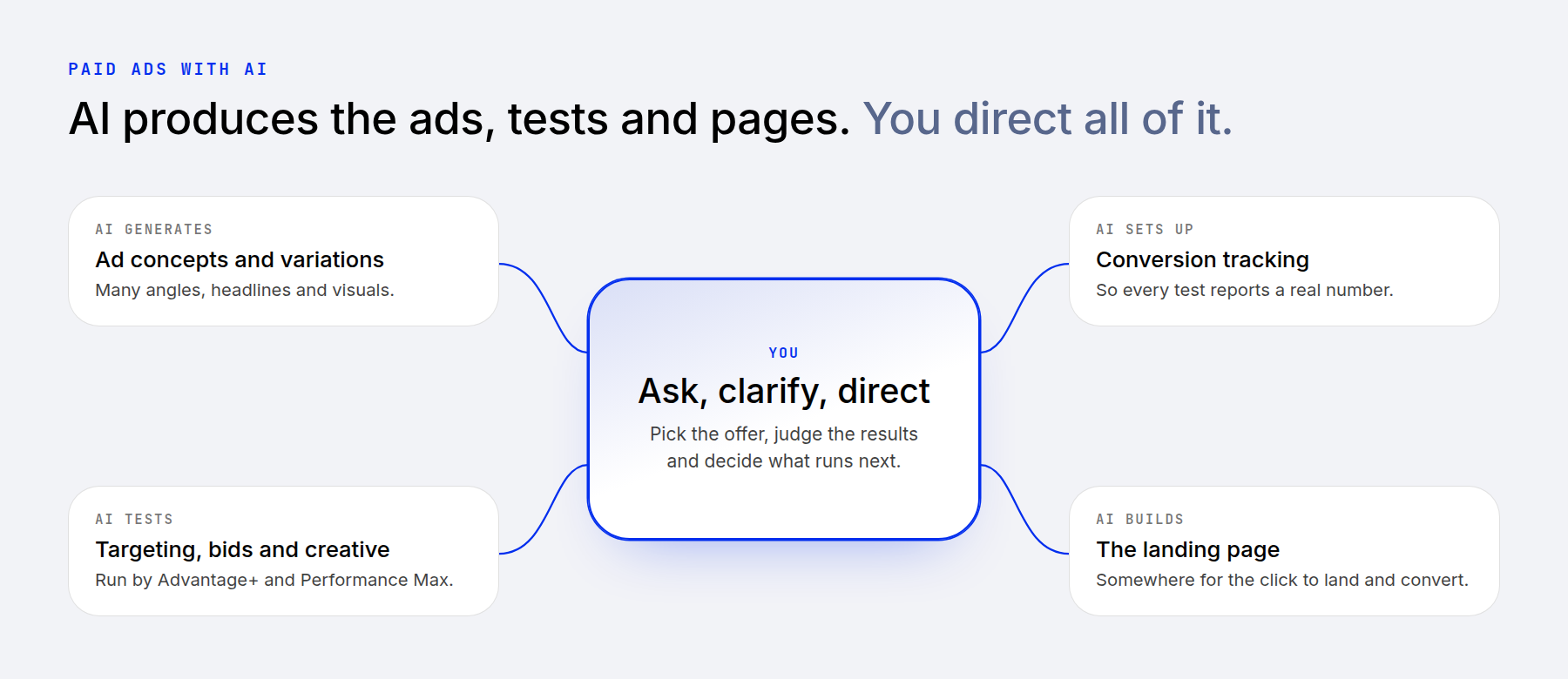
AI now does most of the production in paid advertising. It drafts ad concepts and variations, the platforms test them against audiences and bids, and it can set up conversion tracking and build the landing page. It cannot decide what the campaign is for.
That decision is the service. The person running a client’s ads sits at the center of all that work, asking the client questions, clarifying the offer, and directing each tool toward a result the business can measure.
Let The Platforms’ AI Do The Targeting
Meta’s Advantage+ and Google’s Performance Max hand most of the targeting and creative testing to automation. Fighting that is a losing position. The work is feeding those systems properly: clean conversion tracking, sensible campaign structure, honest exclusions, and enough creative variety for the algorithm to choose from.
The human edge is strategy, creative direction, and an understanding of what automation gets wrong. These systems will happily spend a budget efficiently on the wrong audience, or cannibalize traffic a client was already getting for free, and they will not flag it.
Produce Creative At The Volume The Algorithms Need
Automated campaigns need many variations to test, and producing that volume by hand is what breaks small teams. Start with the tools built into the platforms, which cost nothing extra. Meta’s Advantage+ creative generates variations of the ads you upload, and Google’s Asset Studio creates images and videos for Performance Max and Demand Gen campaigns.
For batch production past that, pick one dedicated tool. Creatify turns a product page into short video ads, AdCreative.ai produces sets of static image ads, and Pencil covers both for brands that want one system.
AI can generate the concepts as well as the variations: new angles, headlines, and visuals in minutes. Your part is choosing which concepts fit the brand and the offer, then telling the tools what to try next. Plenty of businesses run their own ads well and cannot produce enough creative to feed them, so this sells on its own.
Manage Spend With Third-Party Tools
A layer of tools sits above the ad platforms to manage accounts and budgets, and they share the same core job: catch waste, flag anomalies, and automate the routine account hygiene that eats an afternoon a week. Choose where the client spends. Optmyzr is built for Google and Microsoft Ads, Madgicx for Meta-heavy ecommerce accounts, and Bïrch for rule-based automation across several platforms. Adzooma‘s free plan works as a first audit.
You can also connect Claude or ChatGPT to the ad accounts directly. Meta’s official Ads AI connector, in open beta, lets an assistant read reports and make changes, and Google’s Ads MCP server gives read-only access. Keep a person approving every change an assistant makes to the live spend.
These tools require continuous monitoring rather than set-and-forget, which is exactly why the service has value. Small business owners often realize they need help but have no time to learn the platforms or the technology behind them.
Give The Traffic Somewhere To Land
The fastest way to make an ad account look broken is to send good traffic to a bad page. This is the natural companion service to ad management, and it’s the one most freelancers skip. A campaign that finally starts converting usually does so because someone fixed the landing experience, not because the bidding got smarter.
AI makes this side much faster. You can generate and test landing pages in an afternoon with Divi AI Agents or another builder, then iterate on headline and offer against real campaign data. Our guide on how to make a landing page with AI is a good starting point. Selling ads and landing pages together also protects you, because you control both halves of the number the client cares about.
6. Offer SEO And AEO Services
Search Engine Optimization is as challenging as any online skill, involving optimizing a website to rank higher in search engine results. It requires real fluency in search algorithms, content topics, and optimization strategies, which is more than most businesses can manage without hiring someone full-time or on contract. AI Overviews and answer engines like ChatGPT add a second front, since people find answers there as well as in search results.
Answer engine optimization (AEO), also called generative engine optimization (GEO), is the practice of getting a business cited in AI search results. Google’s own guidance says that doing well in its AI features is still SEO: crawlable pages, original content, and structured data that match what is on the page. The new part of the job is measuring it, and most businesses have no idea whether an AI answer mentions them at all.
Work From The Client’s Own Search Data
The strongest SEO service starts with first-party data, meaning the client’s Google Search Console and GA4, not estimates from a third-party index. A class of tools reads that data and watches it for you. SEO Gets, SEO Stack, and SEOcrawl cover the same core jobs: they connect to Search Console and GA4, flag pages that are losing clicks, and run an MCP server. Pick one and learn it well. The differences sit at the edges. SEO Gets shows up to 50,000 rows, where Search Console stops at 1,000, SEO Stack keeps history past Google’s 16-month limit and tracks AI citations, and SEOcrawl adds a site audit.
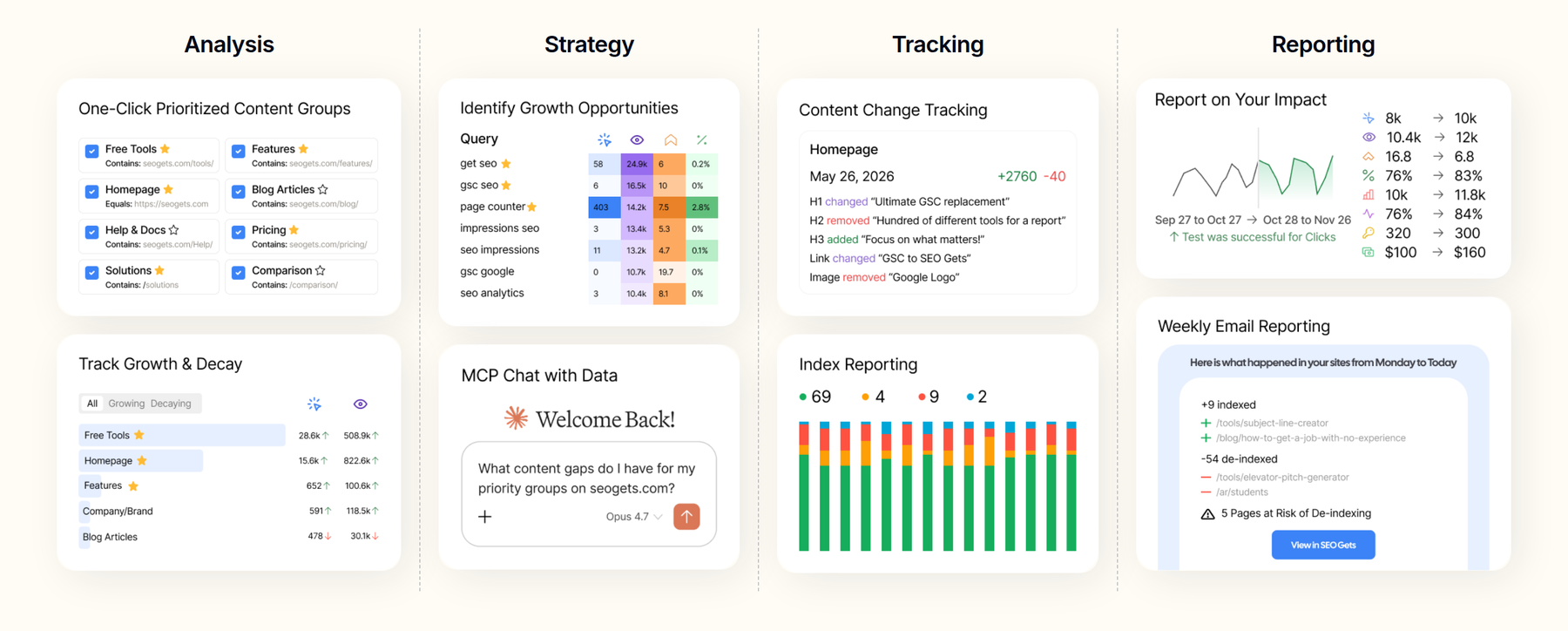
Through that MCP server, Claude or ChatGPT can query the data directly. Ask which pages lost the most clicks in 90 days and which queries they lost, and the answer comes from the client’s real numbers. Ahrefs and Semrush also run official MCP servers, and Bing Webmaster Tools offers a free AI Performance report showing which pages Copilot cites. A monthly decay and anomaly report, with fixes ranked by lost clicks, is a retainer that sells itself once the first report lands. Our roundup of AI SEO tools covers more options.
The Speculative Side: llms.txt And Markdown Pages
Some proposals aim at AI agents directly. llms.txt, proposed by Jeremy Howard of Answer.AI, is a Markdown file at the site root that lists a site’s key pages, and the same proposal suggests serving a clean.md version of each page. Yoast and Rank Math can generate llms.txt for WordPress, and Cloudflare can hand agents a Markdown version of any page that asks for one. For a local business, the file is short enough to read at a glance.
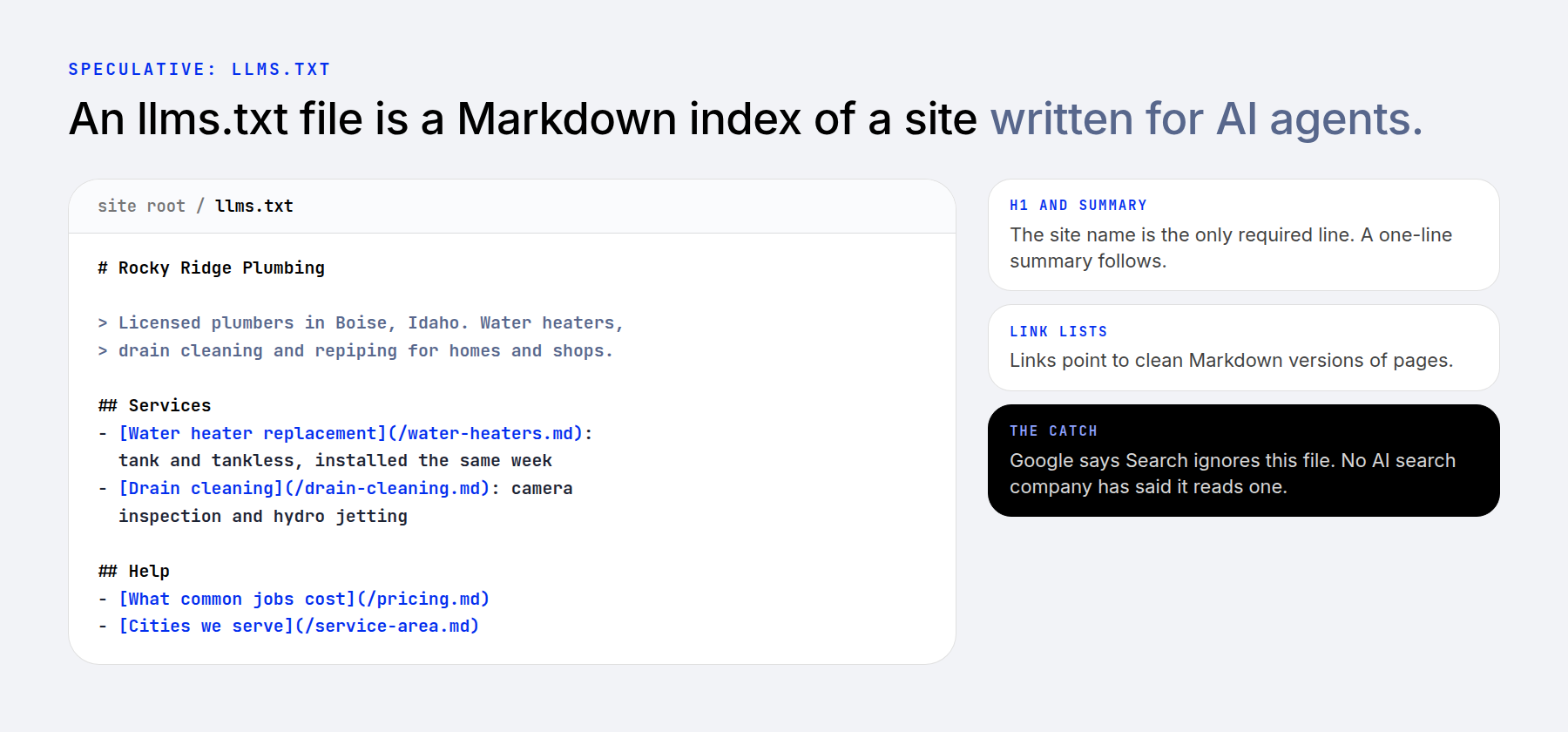
Treat these as cheap experiments, not ranking levers. Google says Search ignores these files and that creating them neither helps nor hurts. None of the AI search companies have said their crawlers read llms.txt, and an Ahrefs study of 137,000 domains found that 97% of the llms.txt files received no requests at all. Set them up when a client asks, and sell the measurement, not the file.
SEO for your own website, if you have one, brings in traffic and revenue too. If you have a WordPress site, these SEO plugins will help.
7. Run YouTube Channels With AI
YouTube videos get cited in AI answers more than any other video source. BrightEdge’s tracking put YouTube first by citation share in both Google’s AI Overviews (29.5%) and AI Mode (16.6%). Across 75,000 brands, Ahrefs found YouTube mentions tracked a brand’s AI visibility more closely than backlinks did, which is a correlation and not proof of cause. A video that answers a customer’s question works in search results and in AI answers at the same time.
For a local business, the videos worth making answer what people ask before they hire: what a repair costs, how long it takes, and what to check first. Plumbers, dentists, accountants, and contractors know those answers cold and have no time to film, edit, and publish them.
Sell A Monthly Channel Service
The service is a monthly retainer: plan the topics, record the expert, edit, publish, and repurpose. One recorded answer becomes a long-form video, a blog post based on its transcript, a few Shorts, and a dubbed version in another language.
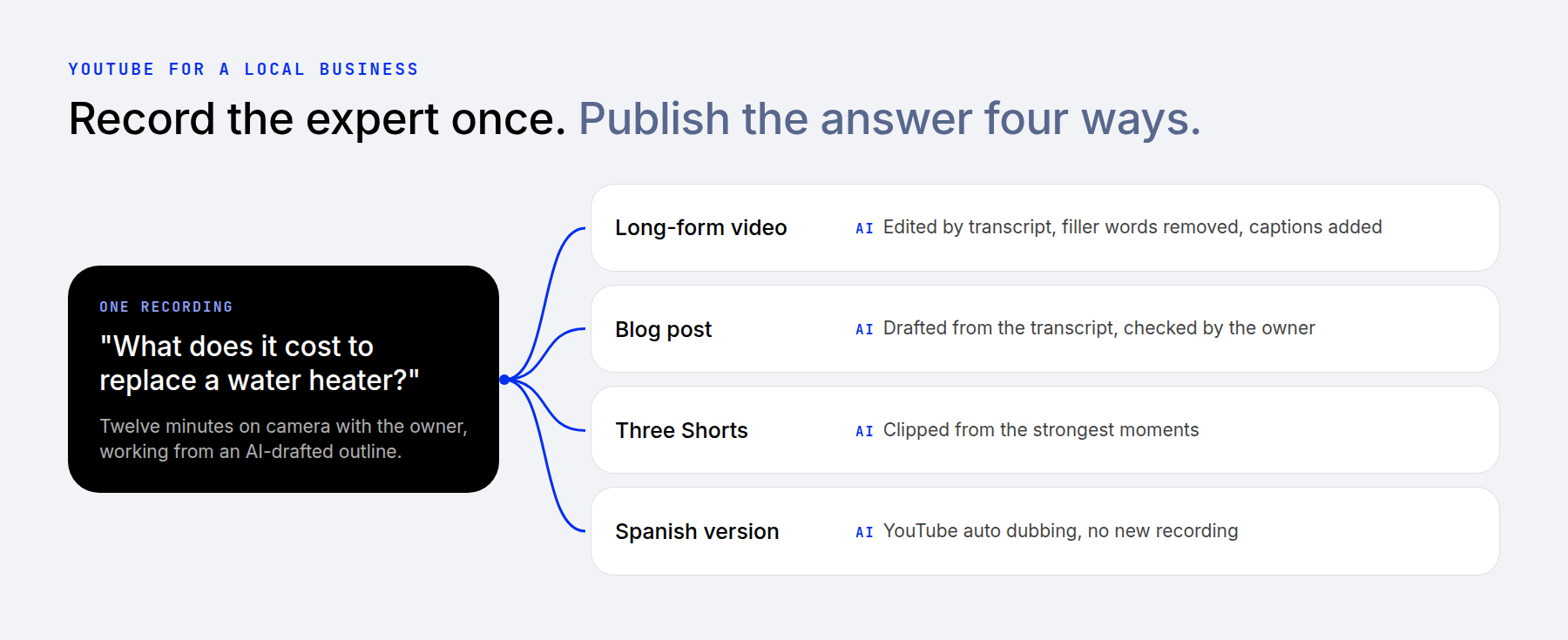
AI handles most of the production between the recording and the upload:
- Scripting: an outline from the owner’s notes or a recorded call, which the expert then says in their own words on camera.
- Editing: Descript edits video by editing the transcript, removing filler words, adding captions, and cutting clips for Shorts.
- Packaging: YouTube Studio tests up to three titles or thumbnails against each other and keeps the winner.
- Reach: YouTube’s auto dubbing translates a video into other languages at no cost.
- Ideas: Ask Studio suggests topics from the channel’s own data.
Transcript editing saves the most time. In Descript, selecting words in the transcript selects the matching footage, so deleting a sentence cuts it from the video.

Know The Rules Before You Scale
YouTube requires a disclosure label for realistic, altered, or synthetic content, but not for content using AI for scripts, captions, or thumbnails. Its monetization policy excludes “inauthentic” content, which covers mass-produced videos built from generic AI templates with no original insight. The Partner Program takes 1,000 subscribers plus 4,000 watch hours in a year, or 10 million Shorts views in 90 days, so ad revenue comes late. The retainer starts in the first month, and the on-camera expert is what keeps the channel on the right side of both rules.
8. Offer Writing Services With AI
I’ll start with my own experience. Before ChatGPT went public, I had a steady stream of freelance assignments in a few micro-niches I knew well. I could turn out a short, solid piece for a brand in about two hours, and there was more of that work than I could take on. After ChatGPT, that market dried up quickly. I don’t expect that particular job to come back.
Since then, I’ve gone deeper into writing and taken on more advanced work. It’s not the same job, and anyone selling writing services should understand which of those two jobs they’re being hired for.
Draft in the frontier labs’ own tools: Claude with Claude Code, or OpenAI’s ChatGPT with Codex. Everyone has the same models, so what you sell is the setup around them and the judgment you add.
Build A Writing Workspace The AI Reads First
Claude Code and Codex both work within a folder on your computer and read the text files in that folder. A file at the top, CLAUDE.md for Claude Code or AGENTS.md for Codex, loads at the start of every session. It holds the standing rules: who you write for, how you format, and the words you avoid. Next to it sits a voice file containing examples of your writing, and a folder for each client with their brief and your interview notes.
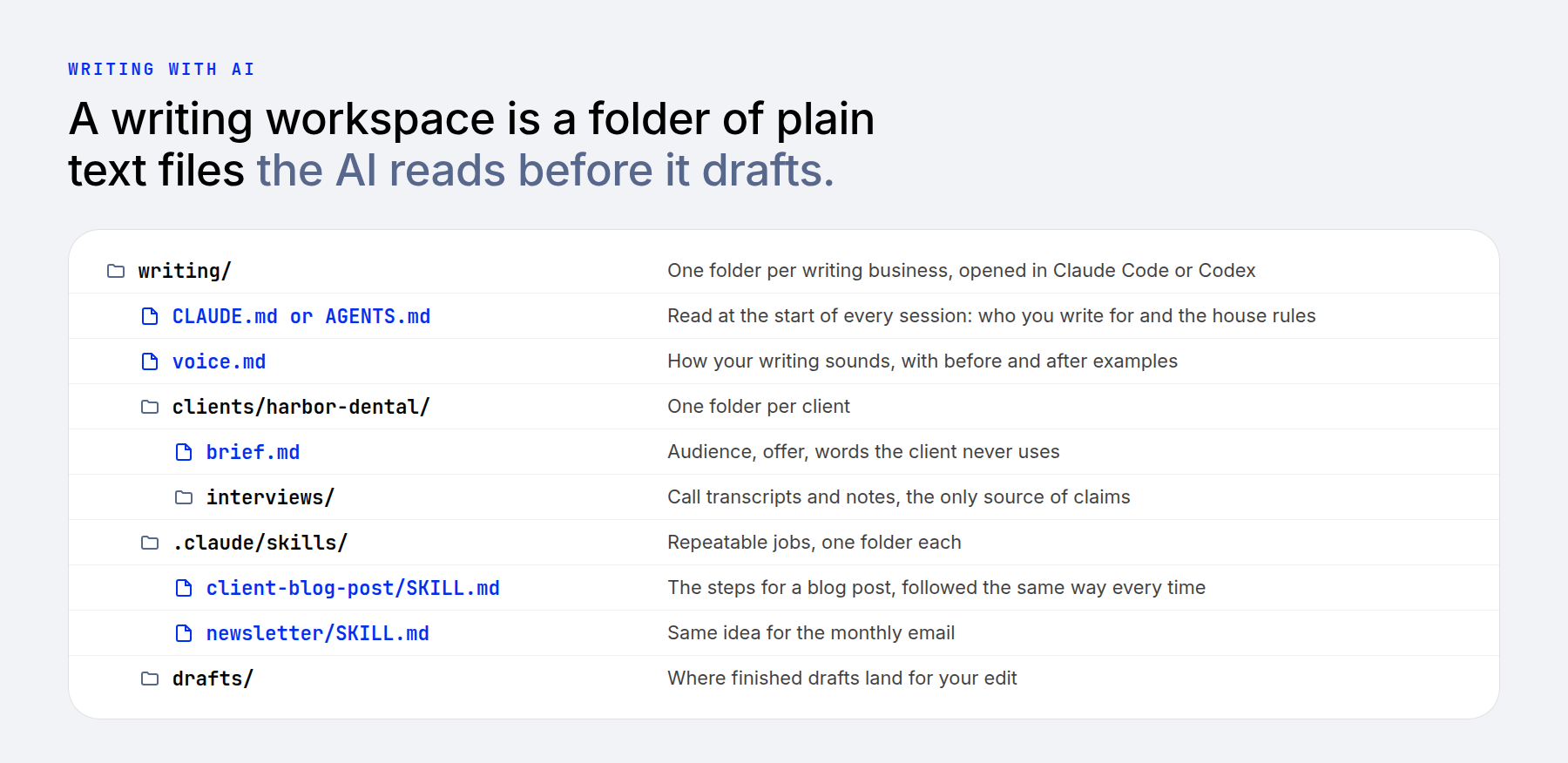
Skills turn a repeated job into a recipe. A skill is a folder with a SKILL.md file inside it. A short description tells the AI when to use the skill, and the steps below it say how that kind of piece gets written. Write one for a client blog post, one for a newsletter, and one for a case study, and every draft starts from the same process.
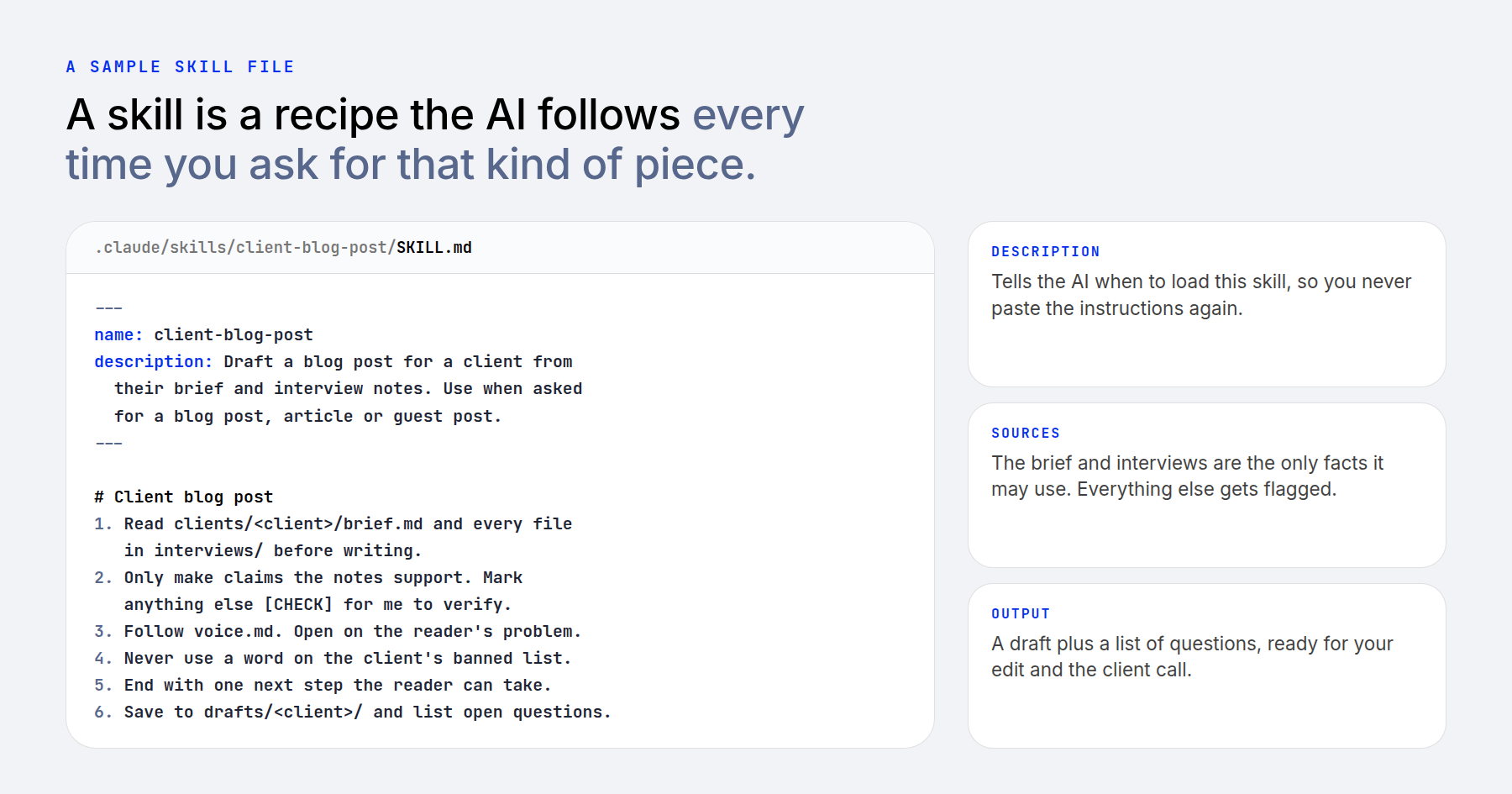
Step two carries the most weight. An AI draft sounds confident whether or not its facts are right. A workspace that allows you to claim only your notes support, and flags the rest for you to check, hands the client a draft built on their facts.
Sell What AI Cannot Supply
Clients pay for the parts a model cannot produce alone: the interview with their team, original research, a point of view, and an editor who catches what is wrong. Price for those. The workspace speeds up drafting, and the judgment you add sets the price. Copywriting pays the most here, because a landing page or an email sequence is measured in revenue. Start with our guides on how to write with AI and on copywriting versus content writing.
9. Run An Affiliate Site With AI Doing The Grunt Work
Affiliate marketing means earning a commission by recommending products, and it is one of the steadiest ways to make money blogging. The field is competitive, and AI Overviews answer many product questions before a reader clicks through. AI helps with the routine parts of the job, and the trust readers place in you is what earns.
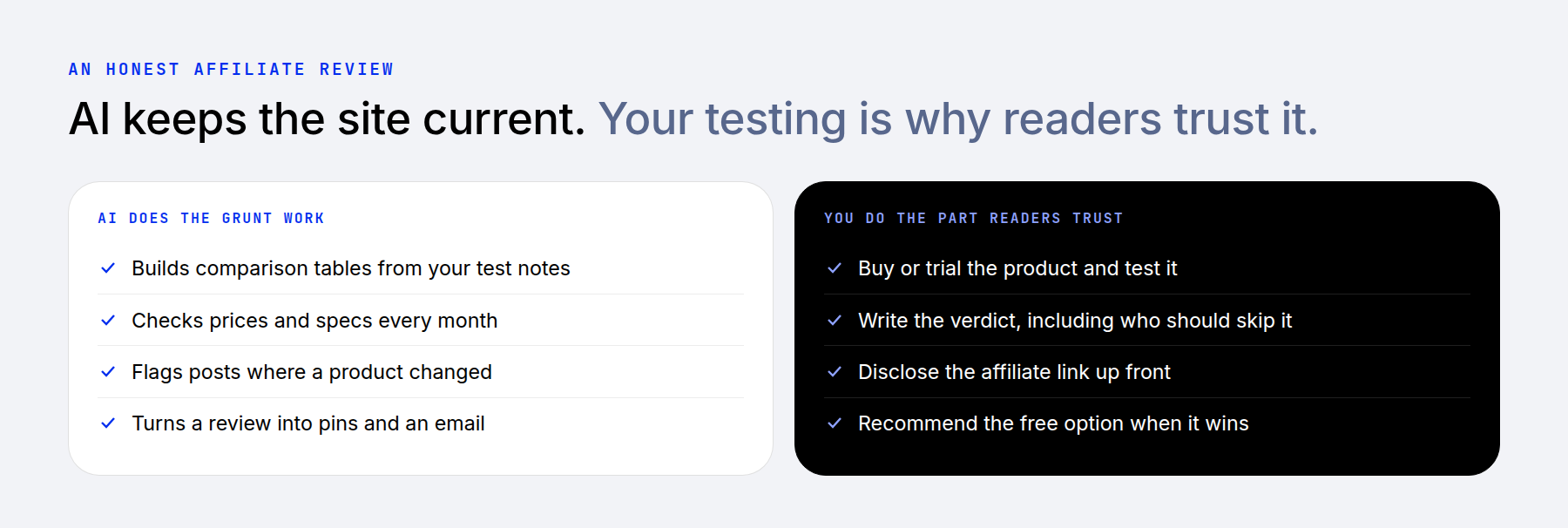
Use it for the grunt work. That means researching a category, drafting outlines, building comparison tables, repurposing a post into an email or video, and automating internal linking. Getting started needs little more than an affiliate website and a writing workspace like the one in #8. WordPress is an excellent platform to build on, with plenty of affiliate plugins to support the technical side.

Plugins for Affiliate Marketers Abound with WordPress
Search isn’t the only way people find posts like these. Pinterest sends real traffic to review and how-to content, and it takes well to AI help, since one article can become a dozen pin variations with keyword-shaped titles and descriptions in a few minutes. Hold it to the same standard as the writing, though. Pinterest rewards images people want to save, and generic AI graphics get scrolled past there like everywhere else.
Do It Ethically Or Don’t Bother
Affiliate income depends on readers trusting your recommendation enough to act on it, so the ethics are the business model. Lose that trust, and the site stops earning.
Recommend only what you’ve used or researched yourself. Never let a model invent a feature, a price, or a verdict, since AI will produce a confident, fluent review of a product it knows nothing current about, and readers and search engines both catch it eventually. Disclose your affiliate relationships plainly and up front, which the FTC requires in the US and which honest publishers do anyway. Say when a product isn’t the right fit, including when the best answer is the free option that pays you nothing. Keep old posts current, because a recommendation can turn into bad advice when a product changes. AI can check prices and specs every month and flag the posts that need you.
Your job is to write reviews, comparisons, and how-to articles that are the best on the subject and to show your audience products they’d find helpful. Building an audience and a strong SEO profile takes time, but it’s very doable in the right niche. Treat it as a side hustle at first, since producing the volume of content it takes to drive traffic takes time. With reasonable work and exposure, an affiliate website in the right niche can become lucrative.
10. Get Paid To Train And Evaluate AI
Models only get better when someone checks their work. That job pays in two places: the AI labs that train the models and the businesses that build their own tools on top of them.
Train Models On A Platform
AI companies pay people to rate model outputs, write reference answers, catch errors, red-team for unsafe behavior, and label data. It is the one path on this list that needs no clients, no portfolio, and no product.
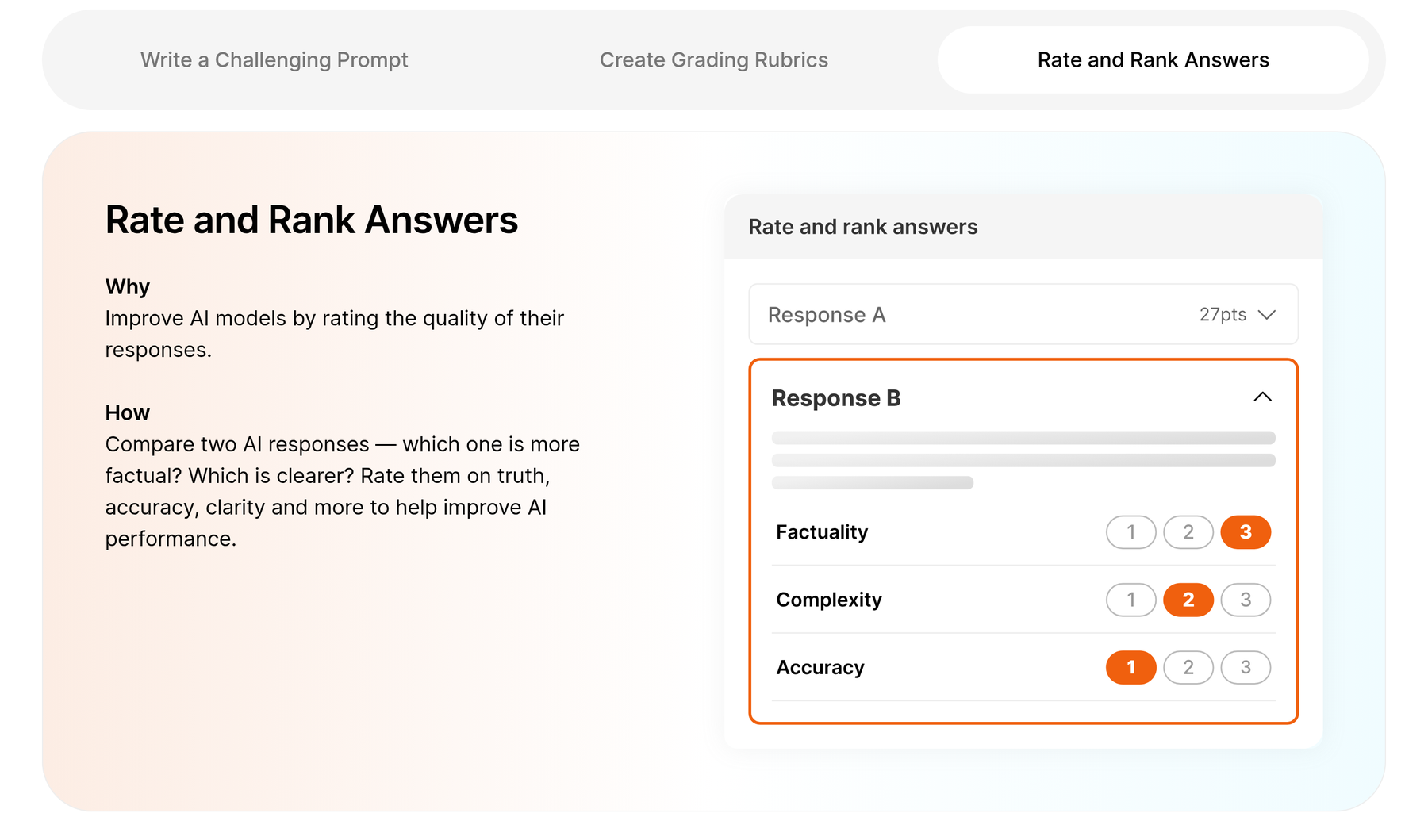
The work runs through platforms such as Surge AI, Mercor, and Scale’s Outlier, and there’s usually a screening exercise before you’re matched with projects. Pay is hourly and varies widely by task. General work sits at ordinary freelance rates. Domain expertise pays considerably better, and there is real demand for backgrounds in law, medicine, finance, translation, and software. A common task on Outlier is to compare two model responses and score each on factuality, complexity, and accuracy.
Know what this is. It’s a job rather than a business; availability comes and goes by project, and it won’t compound the way a client base does. It earns the last slot because you can start this week with no clients and no runway, and you’ll learn more about how these models fail than any course will teach you. That knowledge makes you better at everything else on this list, which is a real reason to take a stretch of it even if you don’t stay.
Build Evals For Businesses That Ship AI
The same skill sells to companies that run their own AI tools, such as a support assistant, a document agent, or a custom harness wrapped around a model. Every new feature, prompt change, and model release can make that tool better or worse, and the drop often surfaces first as a customer complaint.
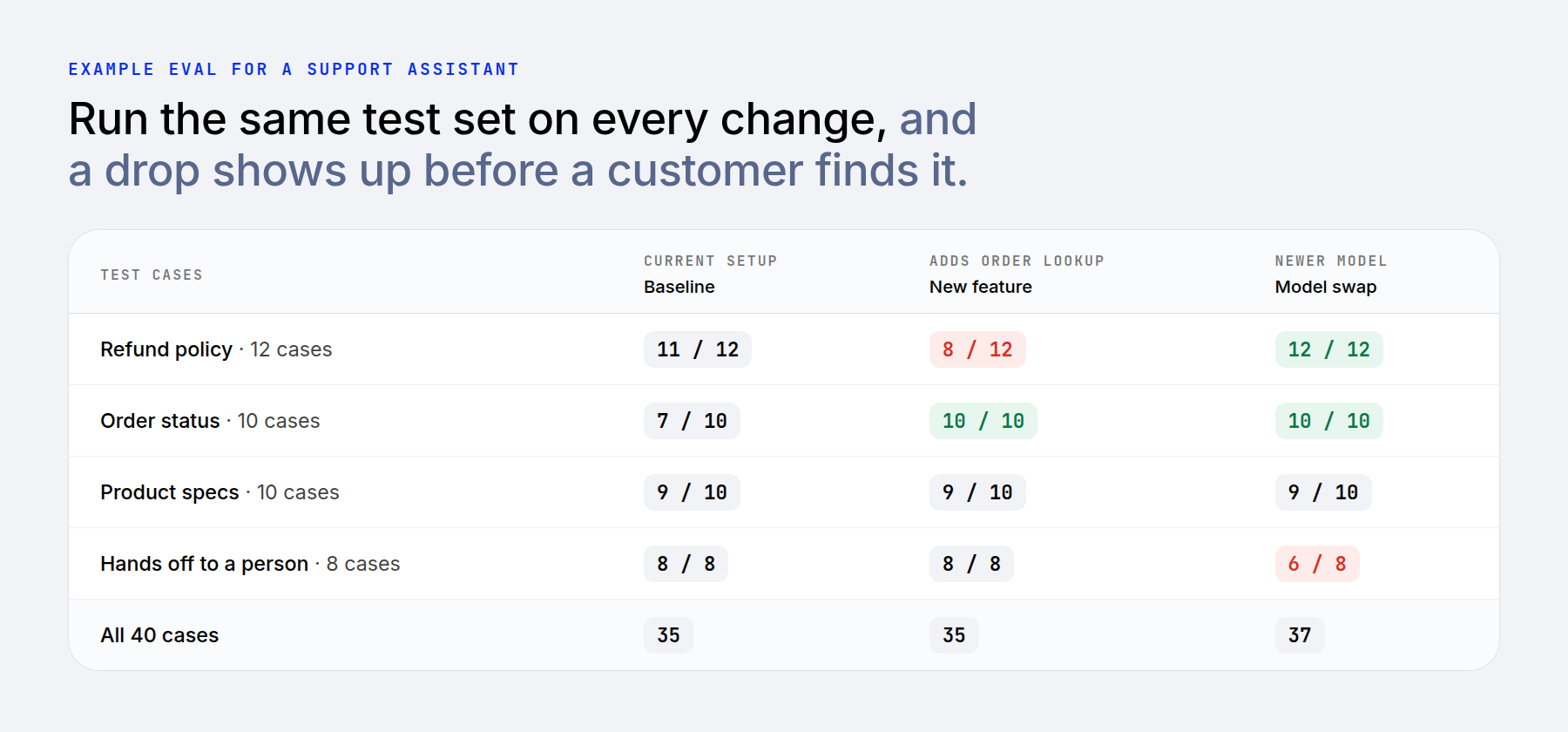
An eval is the check. It is a fixed set of real inputs from the business, each with a way to grade the output: an exact answer when one exists, and a rubric-scored output by a person or a second model when it doesn’t. Model output varies from run to run, so one good answer proves little. A scored set, run on every change, shows whether the tool held its quality. In the example below, a new feature fixes order-status answers and breaks refund answers, and the total score doesn’t move, so the scores are read by category.
Writing test cases that reflect how a business really works takes domain knowledge, and most companies shipping AI have no one assigned to it. Build the suite, run it before each release, and report what moved. That is a retainer, and it grows with every feature the client adds.
What Probably Won’t Work (For 99% Of People)
For balance, here are the AI money ideas that get hyped the hardest and pay off the least. They aren’t scams, exactly. They skip the parts that create value, so almost everyone who tries them ends up with pennies.
- Flooding Amazon with AI-generated books. Kindle Direct Publishing is drowning in low-effort AI ebooks, readers can tell, and Amazon has tightened its rules and limits. Without real expertise and an audience, yours disappears into the pile.
- Fully automated “faceless” content sites and channels. Auto-generated blogs built for ad revenue get flattened by Google’s spam and helpful content updates, and mass-produced, faceless videos get buried or demonetized. Volume without a point doesn’t rank anymore.
- Dumping AI art on stock and print-on-demand marketplaces. Those niches are saturated, and several platforms restrict or ban unlabeled AI uploads. A flood of generic images sells nothing.
- “Passive income” AI trading bots. The ones marketed to beginners are usually scams, not strategies.
- Building an AI app and expecting it to sell itself. Vibe coding makes building easy, so the hard part is distribution. A product nobody hears about earns nothing.
The pattern is the same in every case: a pure volume play that hands the entire job to AI and skips the skill, taste, and distribution that make people pay. That’s the opposite of how the methods above work.
AI Is A Tool, Not A Get-Rich-Quick Hack
Let’s be real for a moment. Artificial intelligence is a force multiplier. It helps us do things faster, smarter, and more efficiently. But like any tool, it’s not a magic wand, and as the tools get more capable and everyone gets access to them, execution and trust count for more, not less. AI works best when paired with legitimate business ideas and good old-fashioned hard work. Think of it as a way to sharpen your skills, offer better services, and create more value. It’s best when it lets you do more of what you’re already good at (or willing to become good at).
Tips For Using AI To Make Money
- Look for Specialized Tasks: AI does a lot of things well, but it’s at its best focused on a specific process or outcome. Break down how you use it into its smallest parts.
- Tools ≠ Tasks: AI tools may help with certain tasks, but don’t assume buying a tool will automatically make you money. Tools must be used expertly to get the most out of them.
- Money is Found in the Hard Tasks: Making money with AI sounds easy, but the real money is in hard work or work that demands experience. If you aren’t willing to offer either, money won’t come easy.
- When You Provide Value, You are Rewarded: Use AI to create real value and make the world (or a business) a little bit better. When you create value, people are eager to reward you with proper compensation. That’s what making money with AI is all about.
How Will You Decide To Make Money Using AI?
From writing and video to coding and marketing, AI is increasingly used as a tool to work more efficiently and create more value. Understanding how to make money with AI can be a significant advantage in your life and career. Remember, AI isn’t about replacing humans or minting effortless passive income. It’s best used with expert human involvement, augmenting our abilities and helping us reach new heights.
We hope you’ve found valuable ideas here and feel encouraged to take a meaningful step. Let us know if you have any questions in the comments, and check out our guides to the best tools for business. Whether you’re looking to write, design, code, or market, we’ve got plenty of content to keep you ahead of the curve.
What way of using AI to make money has got you thinking?
Is it possible to make money with AI?
How can I make passive income with AI?
- Use AI tools to create and sell digital products or courses.
- Create and sell digital art with AI art generator tools. There are AI marketplaces for buying and selling AI art which can help generate passive income.
- Affiliate marketing: With AI tools for website creation, writing, and SEO, it is quite possible to start an affiliate marketing website that can generate passive revenue.
Can I make money with AI bots?
- Build chatbots for businesses: You can sell installation services for chatbots that can provide customer service, set appointments, qualify leads, and answer questions for businesses. You can charge between $100 to $400 or more, depending on the complexity of the bots.
- Sell AI bot templates: You can create a collection of templates for different types of bots and sell them multiple times to generate passive income. Templates can make it easier for businesses and developers to customize their bots. These templates usually include a base prompt that focuses the chatbot to answer only in specific ways.





Thanks so much for this info but how do I sell my work? I’m a content creator.
I mean I want to go into content writing. How do I generate ideas?
How long does it take to start earning out of my contents?
How do I decide what to do first when there are lots of ideas flooding my mind?
Most content writing is paid through services. So, you’d want to develop a writing portfolio (by taking on cheap or free writing work) and then market yourself to people needing your type of writing. I’ve found that LinkedIn and freelance sites (Fiverr and others) are great for this. You earn when someone start paying you for writing tasks.
For generating ideas for what you want to specialize in, I’d stick close to something you know a lot about or something that interests you that you’d have to learn (but are willing to learn). Once you have a specialty, it is a lot easier to sell your writing services.
The other way to make money writing, which is harder, is by making a product of some sort. The two popular ways this is done is by writing a book or creating an affiliate marketing website where you write on a topic (write a lot) and promote certain affiliate products/services. Both of these end up being a product of sorts that people end up ‘using’ that you’d get money from. Both take a lot of commitment.
We hope that helps Juliet!
I’m willing to join and learn how to use AI but I’ll need a mentor to guide
Create a free ChatGPT account. Then paste this prompt to get an AI mentor for your AI journey:
“I’m new to using generative AI for business and commercial purposes. I want to learn how I can use ChatGPT and other AI tools to make a career or side income. Act as my career coach that specializes in leveraging AI for business outcomes. Teach me how to leverage the most in-demand skills that create radical business opportunity, increased revenue, and maximized efficiency. Here is a list of skills outside of AI that I have **list out the skills/interests you have here**. How can I best augment these skills with AI? Give me a list of 10 ideas with a full explanation of each. When we find one that fits my interests, we will go deeper into that and you will give me an actionable plan for learning and career progress that includes skills I need to learn, projects that I can do to prove or show my demonstrable skills, and ways of promoting my services.”
Then have a detailed conversation with ChatGPT.
That should be a good start and it is a completely free AI mentor!
What type of content writing does AI accept
Different AI writing tools specialize in various types of AI writing. You’d, first, have to determine which type of writing you want to get into and learn.
There’s plenty to choose from: copywriting for ads (social media or search ads), copywriting for landing pages, blog content marketing, product content marketing, technical and documentation writing, or story/book/ghostwriting. Each has its own skill set for the person and AI writing tool.
You should start learning about the type of writing you want to do before you start using AI to do it. That way you know best how AI can reasonably help.