


Every website owner should understand the ins and outs of sitemaps. A sitemap tells search engines what exists on your site so that they can show up in search results, and an HTML sitemap helps visitors find their way around once they reach a page. Here’s everything you need to know about sitemap SEO.
What Is An XML Sitemap?
An XML sitemap is a list of the most important pages on a website. Search engines use sitemaps to find and crawl website pages, then add them to search results. A single sitemap can have up to 50,000 URLs and a file size of up to 50MB uncompressed, but some tools set lower limits for the sake of speed. WordPress’s built-in sitemaps hold 2,000 URLs each, and Yoast holds 1,000.
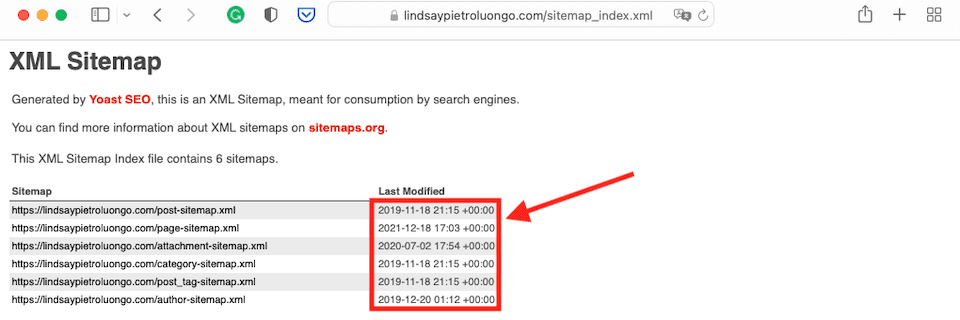
If you go over one of these limits, you can create another sitemap and split the URLs between the two, and you can do this more times if needed. The sitemaps are then combined into one XML sitemap index file for search engines. If you have a ton of blog posts, products, or landing pages, for example, you may need multiple sitemaps in one main file.
That’s not a bad thing. It just means that your site is large enough to need a directory or reference guide for its structure.
What Does A Sitemap Do?
Search engines shouldn’t crawl each and every page of your site. There are some pages that you don’t want to show up in search results, like a “thank you” page that a user will only see after submitting a form. But what about those pages that you do want to be searchable…but that aren’t (yet)?
Think of a sitemap as a roadmap for your website. When some pages that you want to be found are invisible (because there aren’t any internal links pointing to them, making them “orphaned”), a sitemap tells search engines that they exist. In other words, search engines use your sitemap to locate all of your website’s important pages, whether or not you have a complete internal linking structure.
A sitemap can also have a date and time stamp, called lastmod, next to each URL. This tells the search engine when the page was last updated, and Google uses the value when it is consistently accurate. If a date in the sitemap changes, search engines know it’s time to crawl the content again. Google ignores the optional priority and change frequency tags, so you can skip them.
What Is Sitemap SEO?
A sitemap gives search engines another way to discover your important URLs, especially when internal links are sparse. They can also discover a page through links from other sites. Google’s sitemap guidance makes the limit clear: listing a URL does not guarantee crawling, indexing, or a higher ranking. Keep useful internal links in place as well.
Also, by adding a URL to a sitemap, you let the search engine know that you consider that page important. Google treats a sitemap as a hint, though, and listing a URL doesn’t guarantee that it gets crawled or indexed. Keeping weak pages out helps too, since search engines spend their crawling on the pages you want found.
For example, let’s say your site has 500 pages, but only 300 of them are worth finding. Listing just those 300 points search engines straight at the pages you want found, and leaves out thank-you pages, redirects, and anything marked noindex. Google says crawl budget is mainly a concern for sites with over a million pages, or over 10,000 pages that change daily, so for most sites a clean, current sitemap is plenty.
How To Create An XML Sitemap
There are a handful of ways to create an XML sitemap. The good news is that they’re all easy.
Create A Sitemap With WordPress
If you’re using WordPress, there’s a simple way to generate an XML sitemap. Add wp-sitemap.xml to the end of your site’s URL. Voila. WordPress has automatically generated your sitemap, and it lists it in your robots.txt file for you.
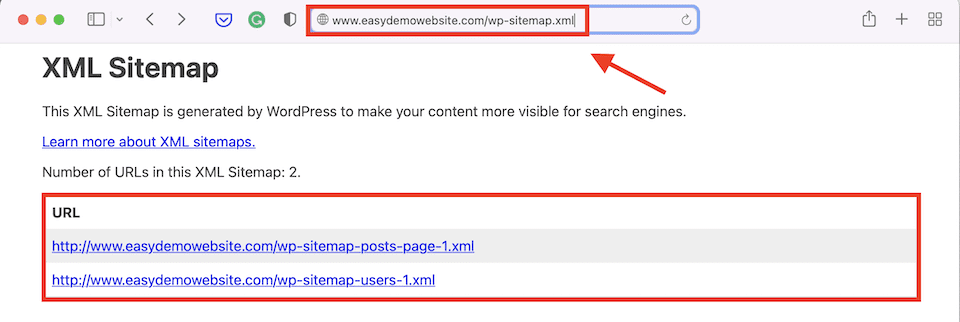
However, this isn’t the best sitemap you can have, so we suggest using a plugin to help. That lets you have more control over what is and isn’t included in the sitemap. SEO plugins like Yoast and Rank Math replace it with their own sitemap, which lives at sitemap_index.xml.
Use A Sitemap SEO Plugin
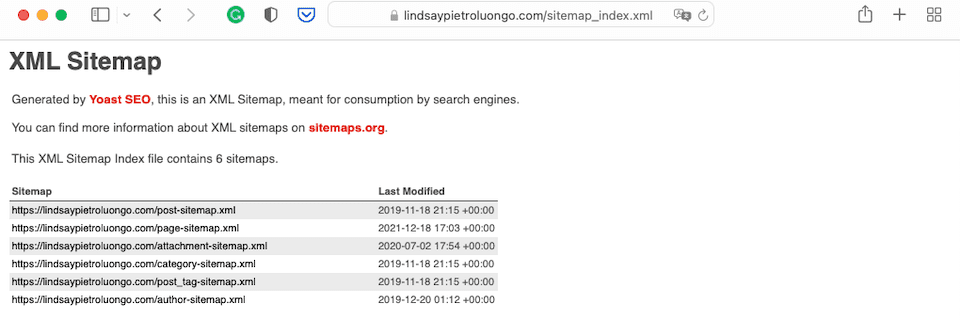
When you create a sitemap using Yoast, your URLs are categorized to make the site structure clear.
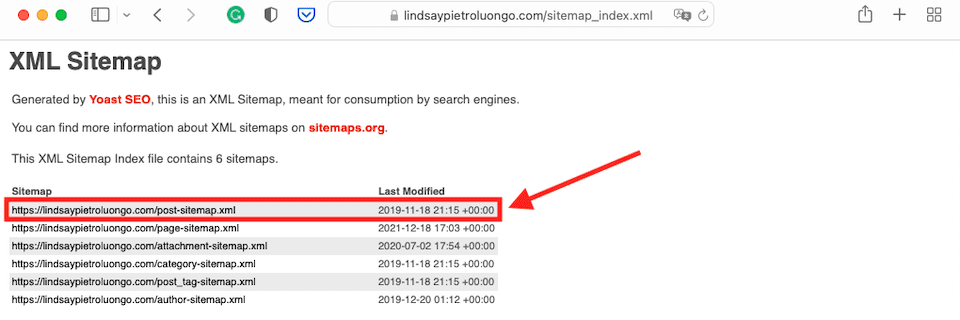
By clicking on one index sitemap (as seen in the above screenshot), you’ll land on a new page with all of the links for that specific sitemap (as seen in the image below).
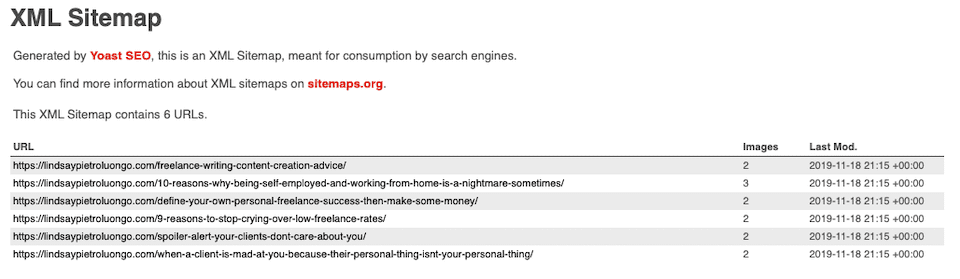
For the most part, a non-Yoast SEO plugin will still create a similar-looking sitemap. There may be slight differences, but it will still work the same.
Creating a sitemap with an SEO plugin is a cinch. Let’s go over how it works in Yoast, and the steps will be similar no matter which plugin you choose.
After installing and activating Yoast, go to Yoast SEO in the left sidebar of the WordPress dashboard and select Settings. Open the Site features tab, then scroll down to Technical SEO to find the XML sitemaps option. Turn it on if it’s not already, then click Save changes.
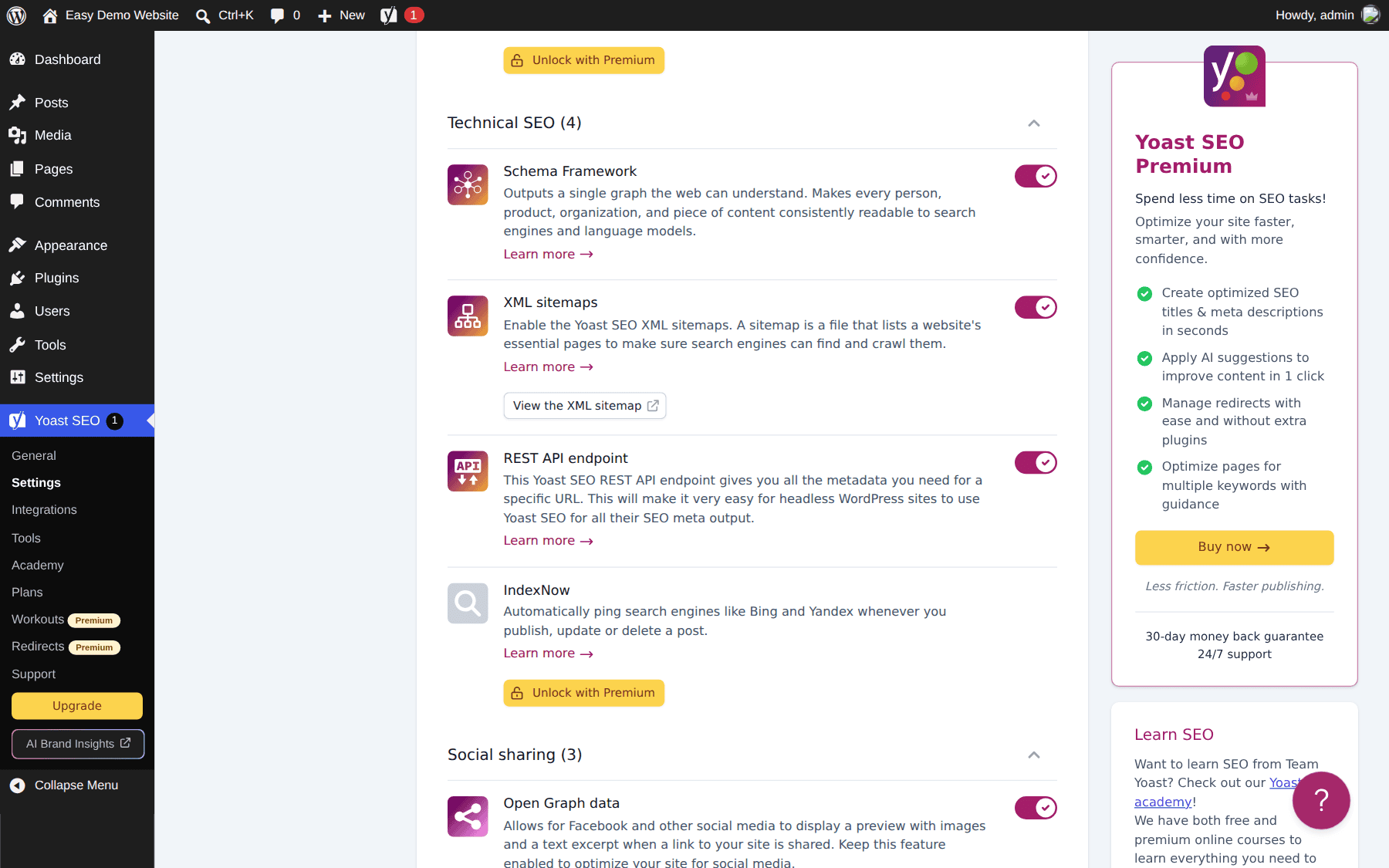
Your sitemap will be generated soon, at which point you can start submitting it to search engines.
More Ways To Create An XML Sitemap
If you don’t have WordPress, you’ll have to create your XML sitemap another way. While there are tools you can find online, Google suggests letting your website software generate the sitemap for you. For example, here’s Squarespace’s documentation about finding its sitemap, and Drupal has an XML sitemap module with information about it here.
It’s generally just as easy as using a plugin with WordPress, but will vary depending on your CMS.
Submit Your Sitemap To Search Engines
Now, you don’t have to submit your XML sitemap to any search engines. If the website has a thorough internal linking structure, search engines can discover the URLs by following those links. Search engines don’t rely on submissions; they crawl and re-crawl websites to find content.
Missing internal links can make pages harder to discover, which makes a sitemap especially useful. In Google Search Console, the Sitemaps report shows whether Google could read your submitted file and reports processing errors. Use Page indexing and URL inspection to investigate individual pages. Our guide to using a sitemap validator to troubleshoot errors covers additional checks for broken and non-canonical URLs.
It’s pretty painless to submit a sitemap, and we have guides for submitting your XML sitemap to Google, Bing and Yandex. Other search engines will have a similar process, and some, like DuckDuckGo, don’t let you submit sitemaps at all.
For those that do, however, it’s a good way to make sure you’re “in their system,” so to speak. You can be sure they know about you, have your site in their queue, and that you will have access to specific tools to help troubleshoot any visibility issues that come up over time.
You can also add a line like Sitemap: https://example.com/sitemap_index.xml to your robots.txt file, which any crawler that reads it will pick up. Google has retired its sitemap ping URL, so Search Console is where you tell Google about a new sitemap. Bing recommends pairing a sitemap with IndexNow, which pings participating search engines the moment a page changes.
HTML Sitemaps Vs. XML Sitemaps
HTML sitemaps are for people, while XML sitemaps are for web crawlers. An HTML sitemap is optional, but it helps visitors on a large site.
HTML Sitemap: Website visitors can see the HTML sitemap, and it helps them find a page that may not be easy to reach from the main menus. Usually, an HTML sitemap is linked to from the website footer:
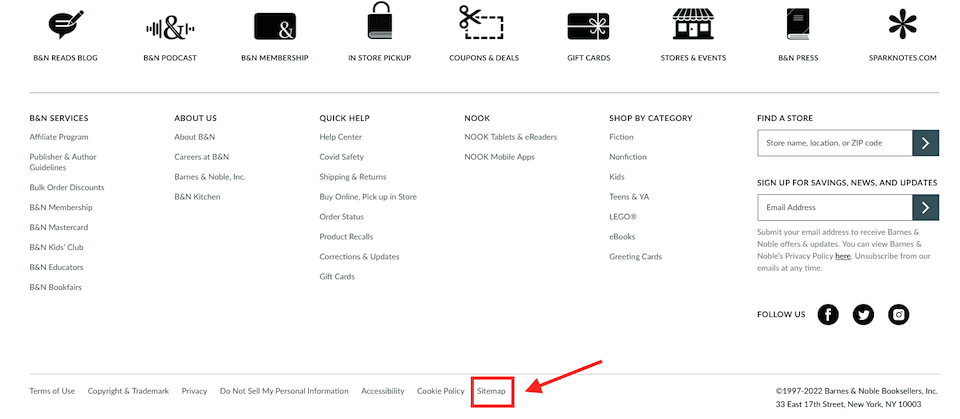
Source: Barnes and Noble
When clicked into, an HTML sitemap will look something like this:
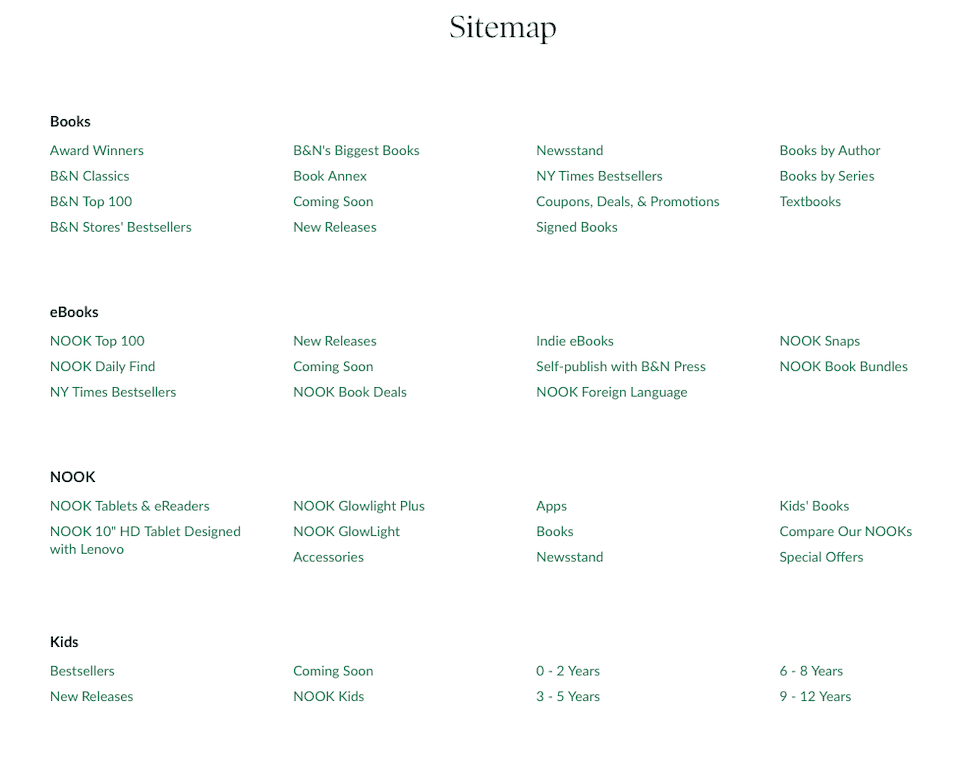
Source: Barnes and Noble
XML Sitemap: The XML sitemap is the most well-known, and it’s the type that search engines can read. Usually, the XML sitemap is in your domain’s root folder, like www.lindsaypietroluongo.com/sitemap_index.xml.
FAQ About Sitemap SEO
What should be included in a sitemap to optimize sitemap SEO?
Should I have more than one sitemap?
What if I have sitemap errors?
Are there different kinds of sitemaps?
Are WordPress sitemaps different from other platforms like Drupal, Joomla, and Squarespace?
What are the best sitemap SEO plugins for WordPress?
Keep Your Sitemap Useful And Current
Your sitemaps tell search engines and visitors where your most important pages are. They also leave out the pages that you don’t want to be found. Both of these efforts can help with your SEO efforts by prioritizing certain URLs and keeping crawlers focused on your best pages. And since creating and submitting sitemaps is a simple process, there’s no reason to skip it.
Want to improve your SEO even more? Once your sitemap is in place, we’ve got everything you need to know about white hat SEO tactics as a followup.






Leave A Reply