

WordPress and Joomla are free, open-source content management systems (CMS) built on PHP. Both grow through third-party themes and extensions, which is one reason each has an active community around it. WordPress runs 58.7% of websites with a known CMS, and Joomla runs 1.6% (W3Techs, 2026-09-30).
For a first site, a blog, a small business site, or a store, WordPress is the usual pick, while Joomla suits technical users who want built-in content types and user management and accept a steeper learning curve.
This comparison covers ease of use, customization, publishing, stores, SEO, cost, and support, so you can choose a platform and start building.
- 1 Quick Comparison Of WordPress And Joomla
- 2 Who Are WordPress And Joomla For?
- 3 Ease Of Use: WordPress And Joomla
- 4 Customization: WordPress And Joomla
- 5 Publishing: WordPress And Joomla
- 6 Built-In Features And Flexibility
- 7 Ecommerce And SEO
- 8 Cost, Hosting, And Support
- 9 Current Versions And Market Share
- 10 The Verdict
- 11 Frequently Asked Questions (FAQs)
Quick Comparison Of WordPress And Joomla
Readers weigh six things when they choose between the two: ease of use, themes and plugins, ecommerce, community and support, built-in flexibility, and cost. The cards below sum up each one.
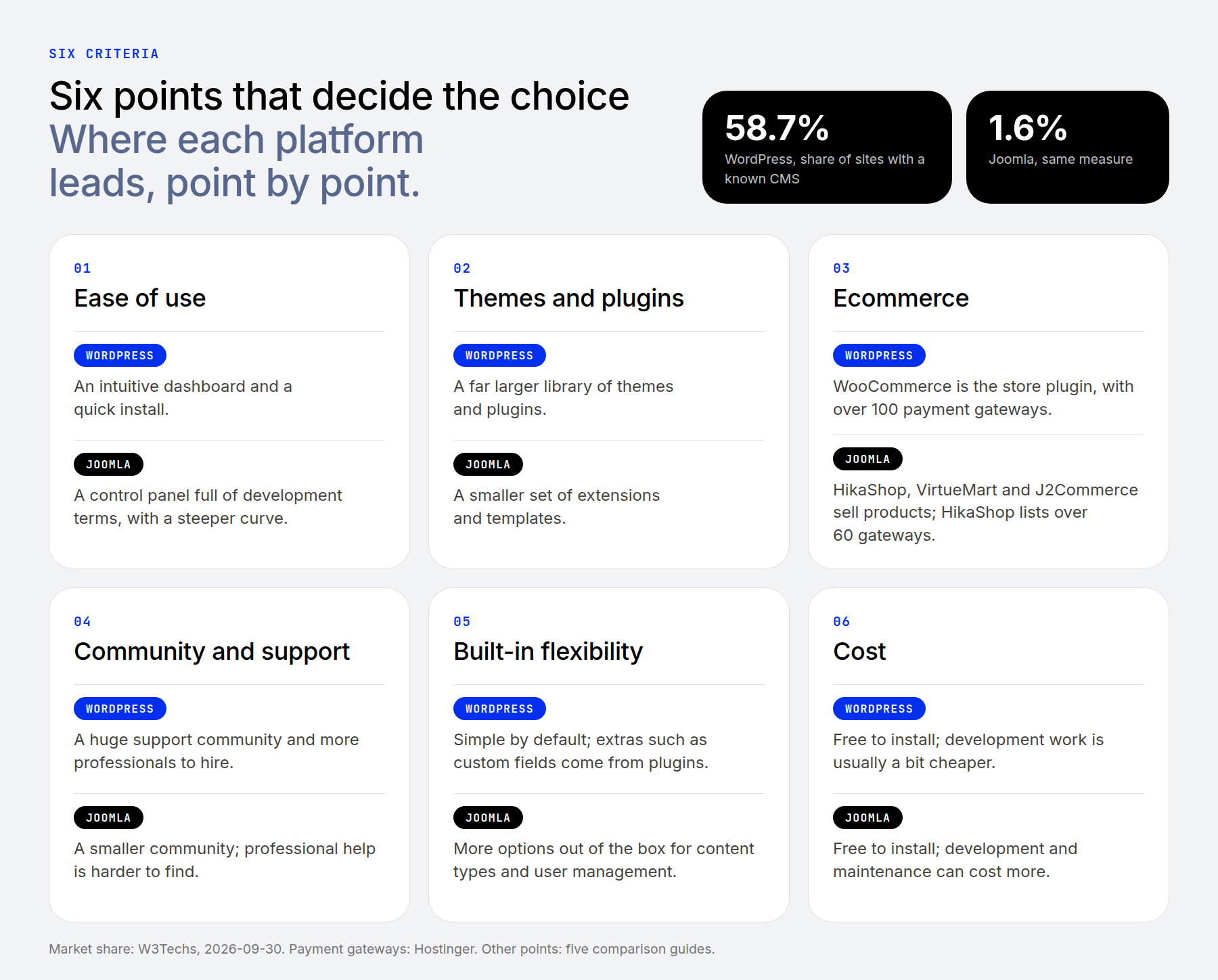
The table repeats the same six points in more detail, and the sections after it cover each in turn.
 |  |
|
|---|---|---|
| Ease of Use | Intuitive dashboard, and many hosts install it in one click. | Control panel full of development terms, with a steeper learning curve. |
| Themes and Plugins | A far larger library of themes and plugins. | A smaller set of extensions and templates. The Joomla Extensions Directory listed 4,932 extensions on 2026-09-30. |
| Ecommerce | WooCommerce, the larger ecosystem. | HikaShop and J2Commerce 6 support Joomla 6. VirtueMart 4 covers Joomla 3.10, 4, and 5, and VirtueMart 5, still in beta, runs on Joomla 6. |
| Community and Support | A huge community, with more professionals to hire. | A smaller community. Professional help can be harder and more expensive to find. |
| Built-In Flexibility | Custom fields, multilingual content, and extra roles come from plugins. | Multilingual content, user groups with access levels, and custom fields are built in. |
| Cost | Free to install. Development work is usually a bit cheaper. | Free to install. Development and maintenance can cost more. |
| Choose WordPress | Choose Joomla |
Who Are WordPress And Joomla For?
WordPress aims to be the jack-of-all-trades CMS. Anyone who needs a website can build one with it, and generally with minimal experience, because the tools are easy to find and understand through third-party plugins and themes.
Users find a mild learning curve with WordPress, but it doesn’t take long to get past it. You will soon be working with posts, pages, themes, and plugins. Someone brand new to websites can build a solid WordPress site without much trouble.
Joomla is also a general-purpose CMS. It was created as a full-site CMS from the start, while WordPress began as blogging software, so its features and updates still build on that foundation.
Joomla is harder for beginners. Its control panel uses more development terminology, and installing extensions takes more technical steps. For people with tech and website experience, Joomla offers a lot of freedom. A site that outgrows it can move: see our guide to migrating Joomla to WordPress.
Ease Of Use: WordPress And Joomla
WordPress has a moderate learning curve for new users, and nearly every feature comes down to creating a post or page. Themes and plugins expand on that. Joomla is aimed at site developers, so non-technical users face a steeper climb. People with a web development background may find Joomla just as smooth.
WordPress
The WordPress dashboard lists the main areas, such as Posts, Media, Pages, and Comments, in the left-hand sidebar.
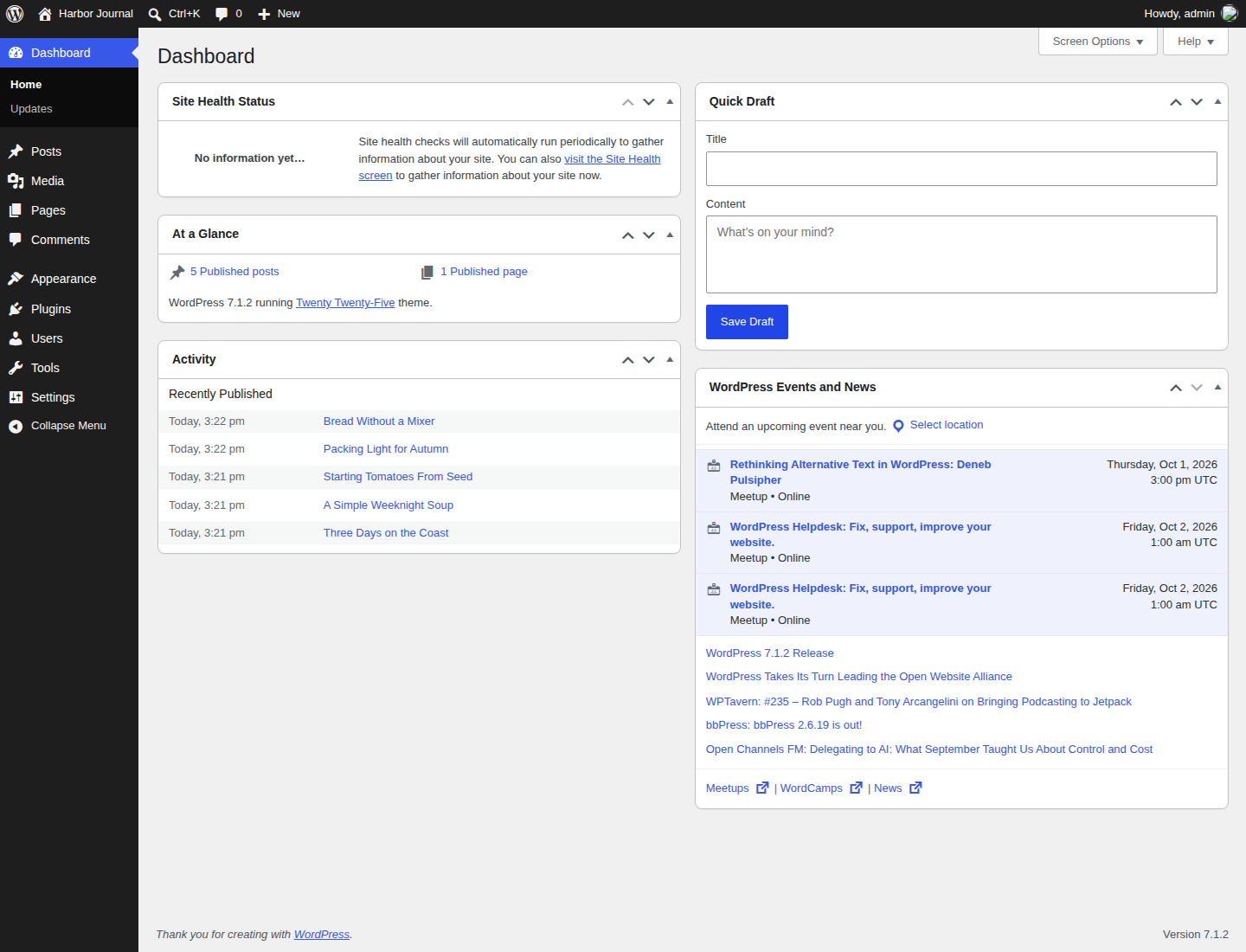
You do have to learn where certain elements live, such as settings and menu editing. Once you know where they are, the interface is easy to work with.
Choosing the right plugins for your theme is one of the harder parts. The WordPress.org repositories hold thousands of free themes and plugins, and third-party developers sell even more premium options, such as Divi. If you are new, you may not know which features your site needs. That gets clearer after a little time with the platform.
Because the base of WordPress is posts and pages, most tasks take a few clicks. The basic workflow becomes familiar quickly, with only small variations from task to task.
Joomla
Joomla has a steeper start. If you are an average web user setting up a new website, it may not make much sense at first. If you have built or coded websites before, it is easier to pick up.
Joomla 6.1.4 uses the Atum admin with a collapsible left sidebar. It lists Home Dashboard, Content, Menus, Components, Users, System, and Help, and each entry opens its submenu inside that sidebar. The header bar carries the version, the tour, notifications, and the user menu.
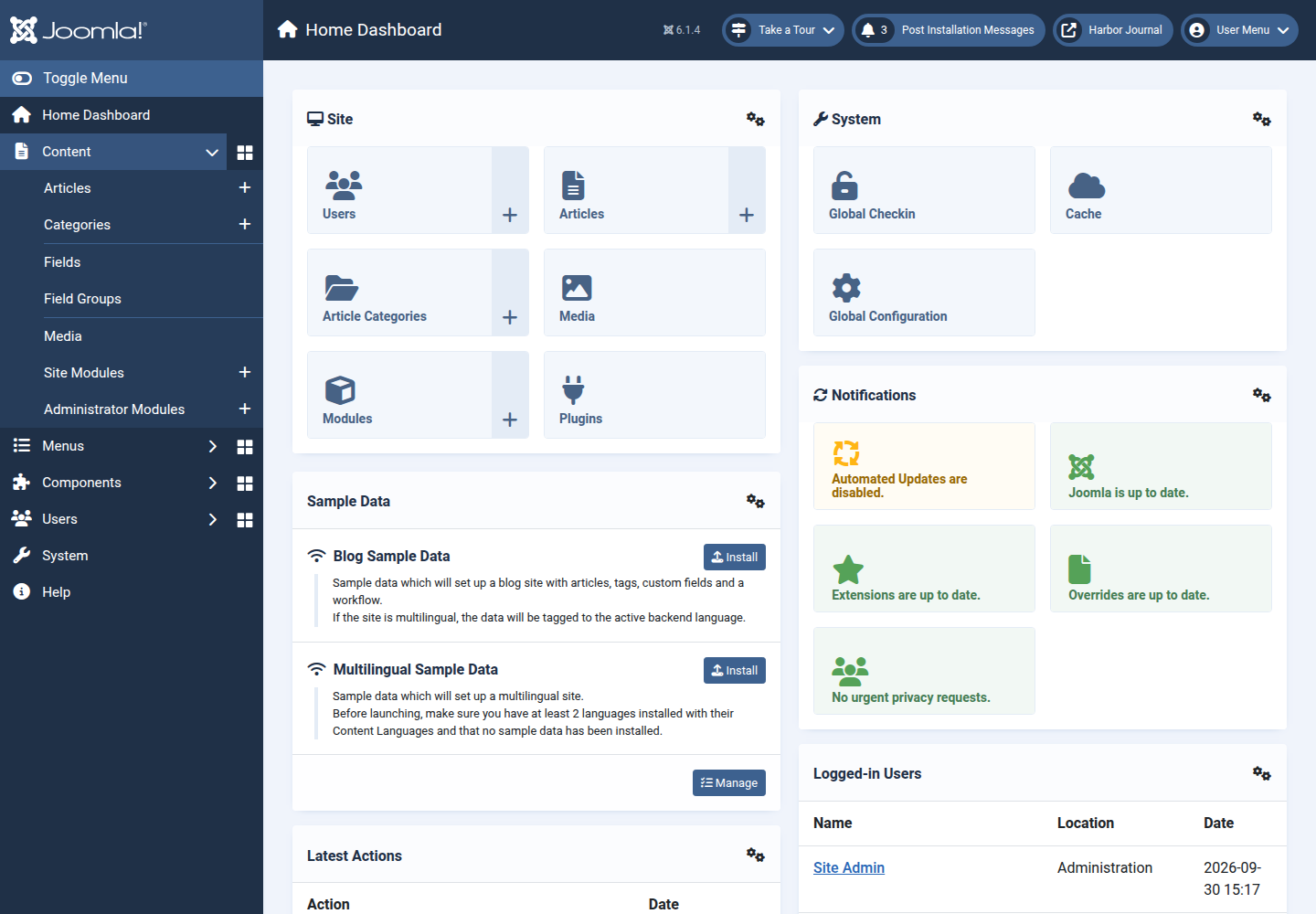
The installer does not offer sample content. Instead, the Home Dashboard has a Sample Data module with Blog Sample Data and Multilingual Sample Data, each with an Install button. Joomla asks you to confirm first because the process can’t be reverted, and the blog set added 4 categories, 11 articles, tags, custom fields, and a workflow. Its articles work as orientation material, so it suits a practice site.
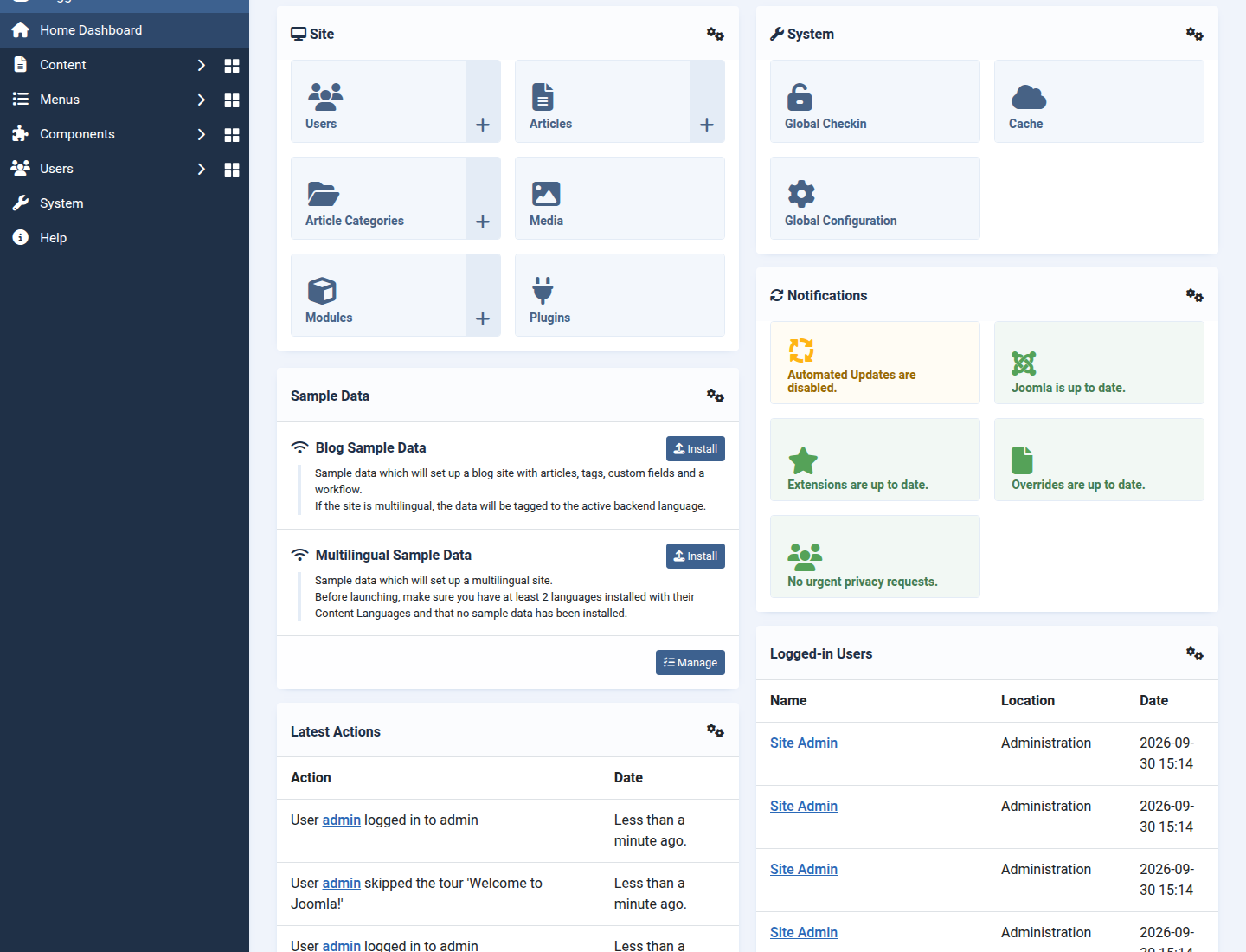
Joomla’s documentation includes a set of beginner tutorials for learning the platform. Joomla is developer-friendly, but it asks more of end users than WordPress does.
Customization: WordPress And Joomla
WordPress thrives on customization. Plugins and themes allow a wide range of designs and feature sets, and a user with no technical experience can launch a professional-looking site. Joomla is also built around customization, but it asks for more technical skill to get right.
WordPress
Through plugins and themes, WordPress can be whatever you need. You can add ecommerce features with a few clicks. You can install a page builder for more control than the Gutenberg editor offers. Divi is one, and its Visual Builder and Theme Builder cover pages, headers, footers, and the other templates a site needs.
Block themes such as Twenty Twenty-Five keep their design controls in the Site Editor. Its Styles panel holds Typography, Colors, Background, Shadows, and Layout settings. Classic themes keep their options in the Theme Customizer.
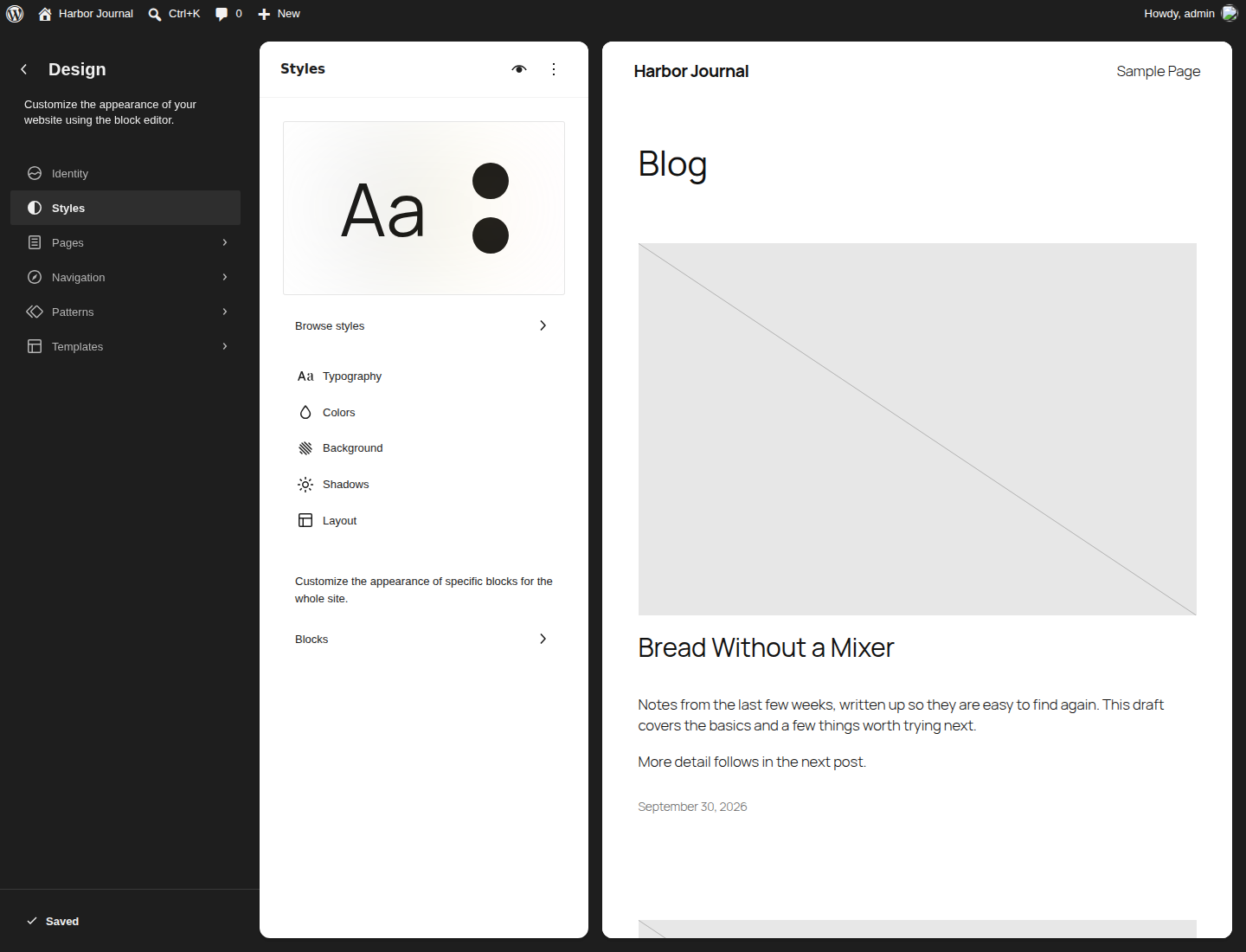
Developers can add custom CSS or edit theme files directly. A child theme holds those customizations separately, so the parent theme stays intact to fall back on. WordPress encourages trying different themes and plugins to see what fits your site.
Divi 5 puts its design tools inside the builder itself, including CSS Grid, design variables, presets, and a Loop Builder for dynamic content. That covers a good share of what a WordPress site would otherwise add through separate tools.
The Divi AI Agents add a command interface that understands natural language and takes actions inside the builder. An agent creates, edits, and deletes modules, and it can start from a plain-language description, a screenshot, a mockup, a website URL, or a mood board. It also reaches past the layout into WordPress: it creates, updates, publishes, and schedules pages and posts, and it manages navigation menus, Theme Builder templates, and global settings.
Three features keep the agent consistent across a project. Rules hold a site’s preferences and design conventions, Commands save a repeated prompt as a reusable workflow, and Context points the agent at specific modules, pages, or media. Sweeping changes such as alt text, color consolidation, typography standardization, and responsive fixes are the examples Divi gives for this kind of work.
Joomla
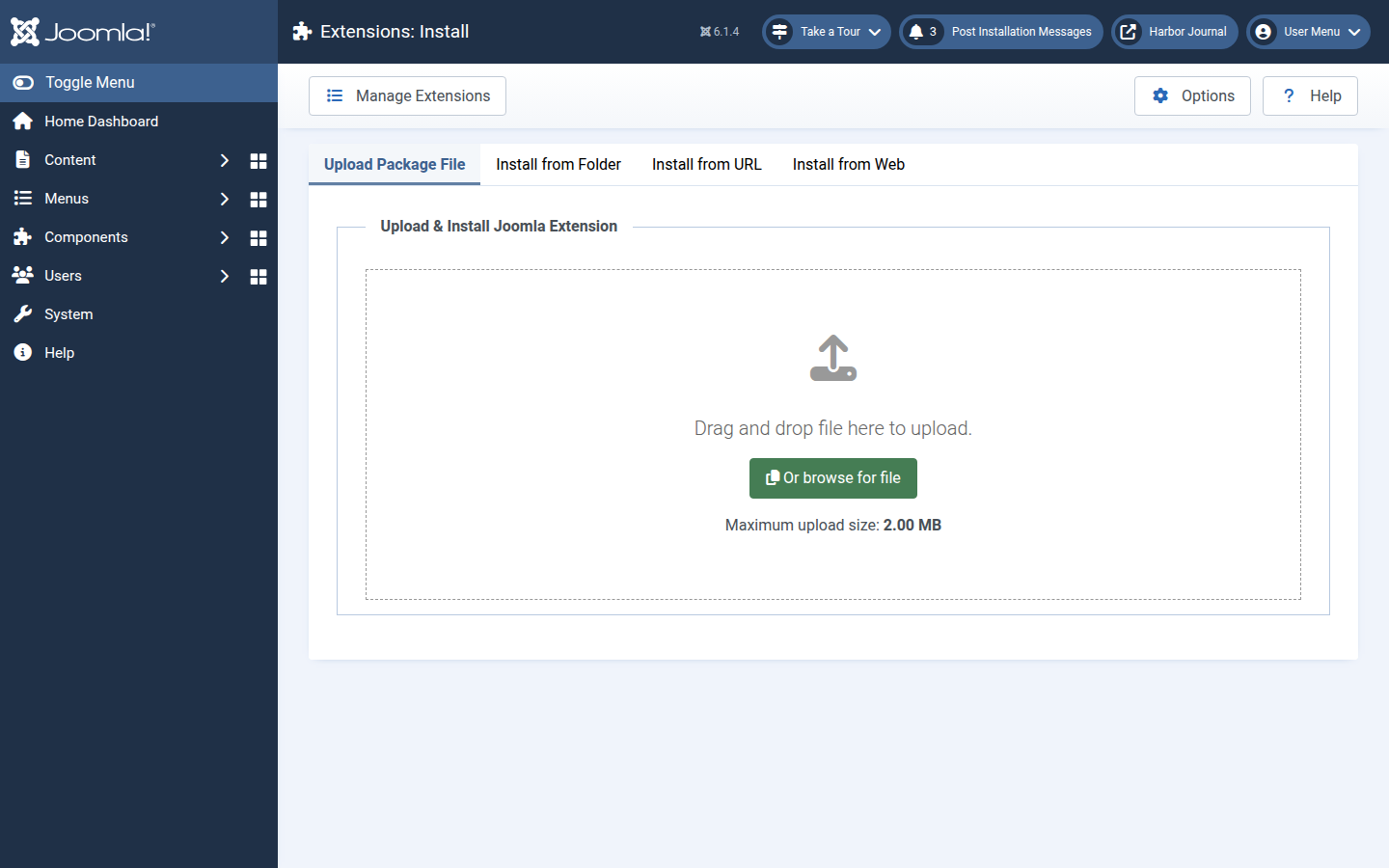
Joomla is also customizable, since the Joomla Extensions Directory listed 4,932 extensions on 2026-09-30, and templates are one of its categories. In Extensions > Install, the Install from Web tab sits beside Upload Package File, Install from Folder, and Install from URL.
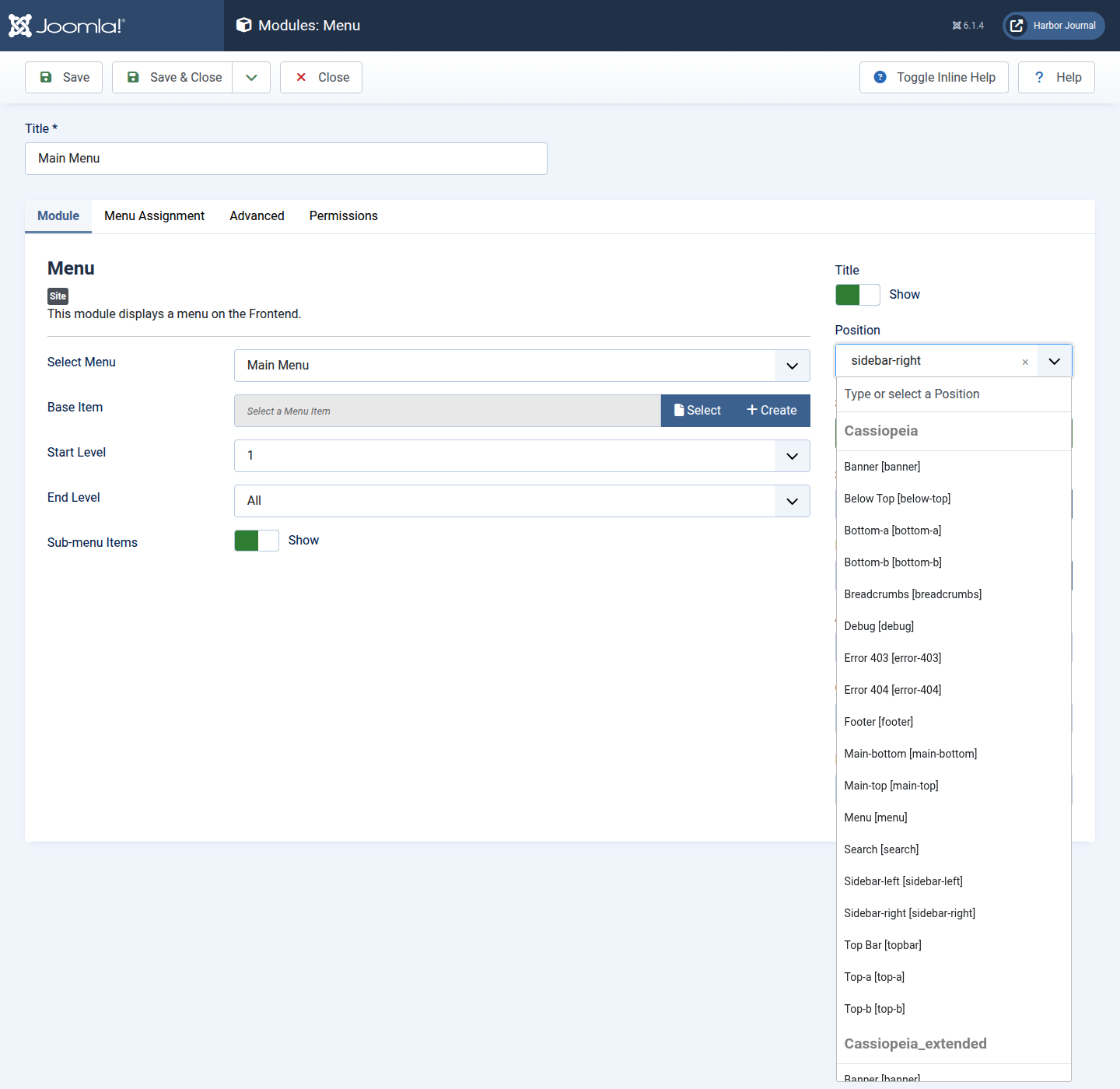
After you install an extension, you enable it and adjust its settings from the admin. Placing a module means choosing a position from a searchable dropdown grouped by template, where each entry has a name and a code, such as Sidebar-right [sidebar-right] and Top-a [top-a] under the default Cassiopeia template. Each template defines its own positions.
Joomla gives you as much freedom as WordPress, but the options are more complicated to get right. You will work harder for the same result when you compare Joomla and WordPress.
Publishing: WordPress And Joomla
Your site exists to display content, so the publishing experience counts. WordPress is a blogging platform at heart. Anyone can publish to the site’s feed or add a static page just as easily. Joomla isn’t made only for regular posts. Every page and post lives under Articles, and categories sort them.
WordPress
WordPress 5.0 introduced the block editor in December 2018. It replaced the classic editor, which was TinyMCE. Content creators can control options for every paragraph, image, gallery, or embed. Some in the community dislike it, but the interface is clean, and it works for both blog posts and static pages.
Post types are separate in the interface, so it is clear what you are creating. Posts are for regular content. Pages are for static content that stays out of the feed. Custom Post Types add things like Products for plugins such as WooCommerce.
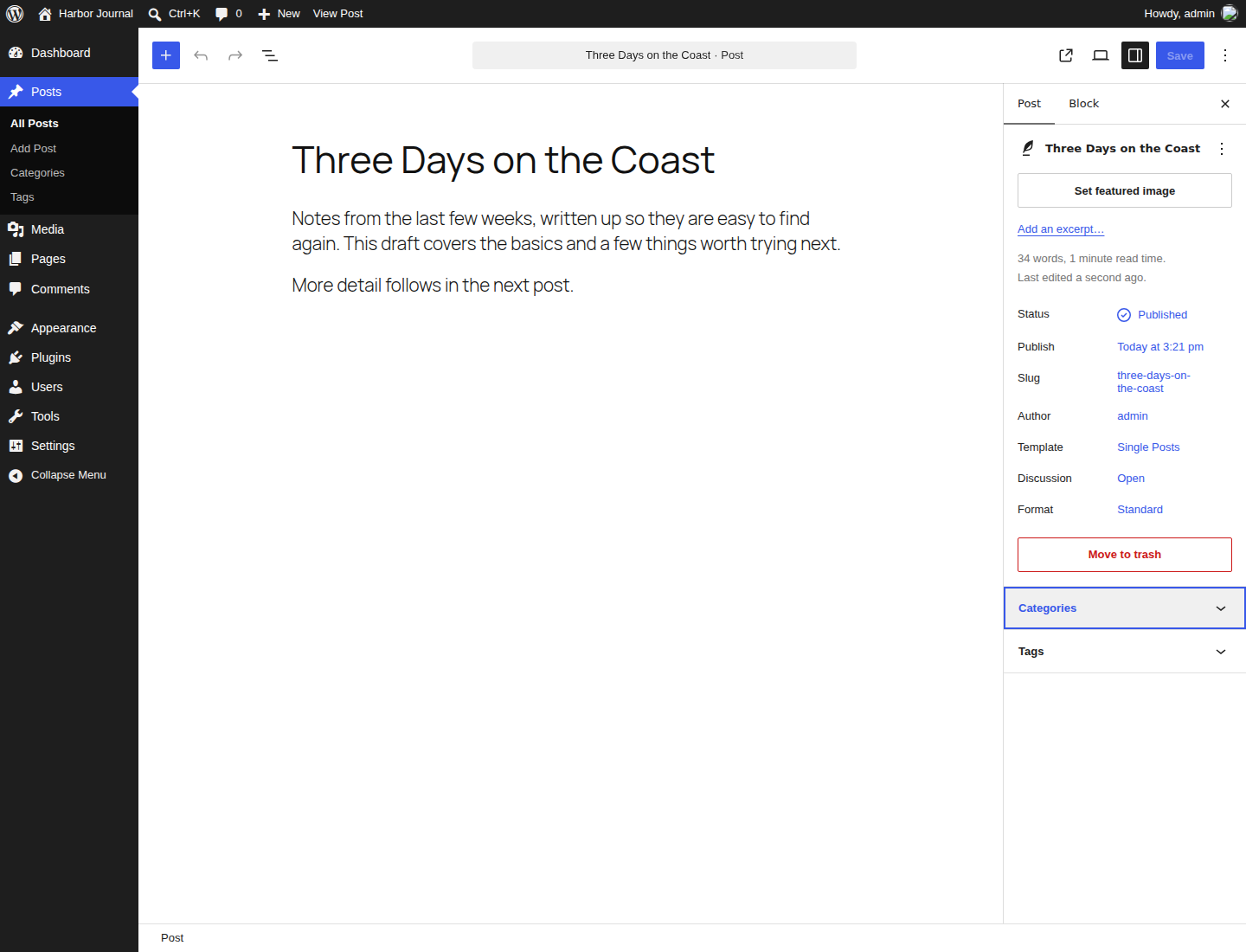
Posts > Add Post opens the editor. The Post tab in the sidebar holds the status, publish date, slug, author, template, and format, with Categories and Tags panels below.
Joomla
In Joomla, creating content is about as direct as in WordPress. Its default editor is TinyMCE, the editor WordPress used before 5.0, and Joomla 6 moved it from TinyMCE 6 to 8. Anyone who knows a WYSIWYG editor will feel at home.
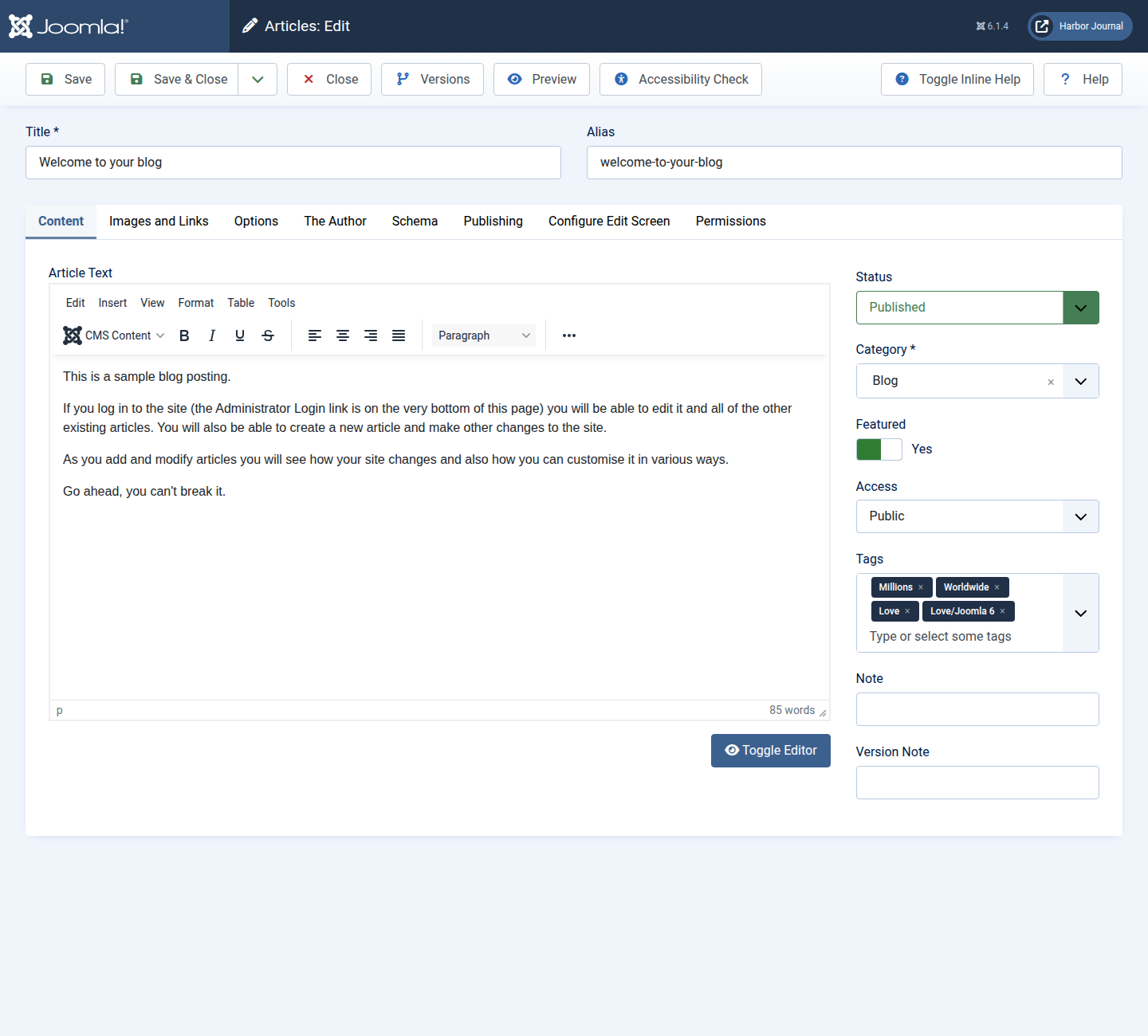
One screen holds the Title, Alias, Category, Access, Status, Featured, and Tags fields. Joomla’s version of a permalink is the Alias. Access sets who can see the article.
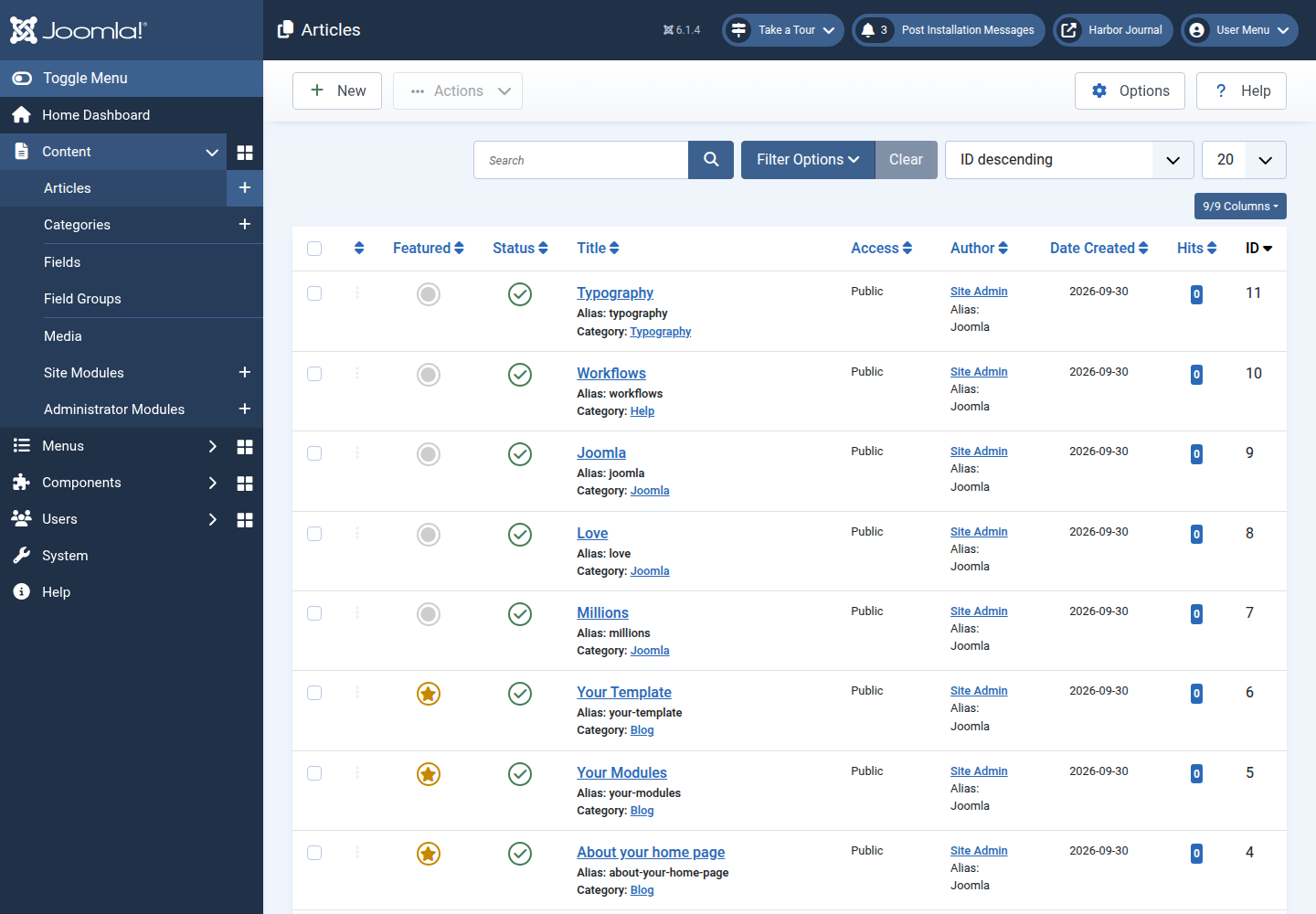
The same Add New Article button opens this editor for blog-style content and static pages. The Category keeps them apart. Categories and menu items decide where an article appears, and the Articles list shows each row’s category under its title.
Setting up the right categories to match your content and modules takes more planning than WordPress taxonomies. For sites that don’t publish regular content, Joomla’s structure can keep things organized.
Built-In Features And Flexibility
Joomla ships with more of the structure a complex site needs. Its core includes multilingual content, user groups with access levels, and custom fields. WordPress reaches the same place with plugins, such as WPML or Polylang for multiple languages and Advanced Custom Fields for custom fields.
Joomla 6.1 adds module versioning, module association across languages, a visual workflow editor, media custom fields, and proof-of-work CAPTCHA. Those built-ins help most when a site needs them from day one. A WordPress plugin can cover the same ground, so they rarely decide the choice alone.
Ecommerce And SEO
WooCommerce is the main ecommerce plugin for WordPress, and it has the larger ecosystem behind it. Our guide to installing WooCommerce covers the setup, and Divi’s WooCommerce modules handle store design.
Joomla has stores too. VirtueMart, HikaShop, and J2Commerce (formerly J2Store) are the well-known options, and HikaShop has a free Starter edition. One comparison (Hostinger, updated 2026-04-16) counts over 100 payment gateways for WooCommerce and over 60 for HikaShop. On Joomla 6 specifically, HikaShop and J2Commerce 6 both list support. VirtueMart 4 covers Joomla 3.10, 4, and 5 only, and VirtueMart 5, which runs on Joomla 6, is still in beta (checked 2026-09-30).
Joomla includes SEO settings in core: search-friendly URLs, URL rewriting, and meta fields for each article. URL rewriting needs mod_rewrite on the server. WordPress lets you edit each post’s permalink, and SEO plugins such as Rank Math, Yoast SEO, and All in One SEO add more controls.
Cost, Hosting, And Support
Both platforms are free to install, so you pay for hosting, premium templates and extensions, and developer time. WordPress development usually costs a bit less, while Joomla development and maintenance can cost more. No source puts a figure on the gap.
Many hosts install WordPress in one click, but Joomla 6 needs PHP 8.3 at minimum (8.4 is recommended) and MySQL 8.0.13 or later, MariaDB 10.6 or later, or PostgreSQL 14 or later. Confirm your host meets those versions first.
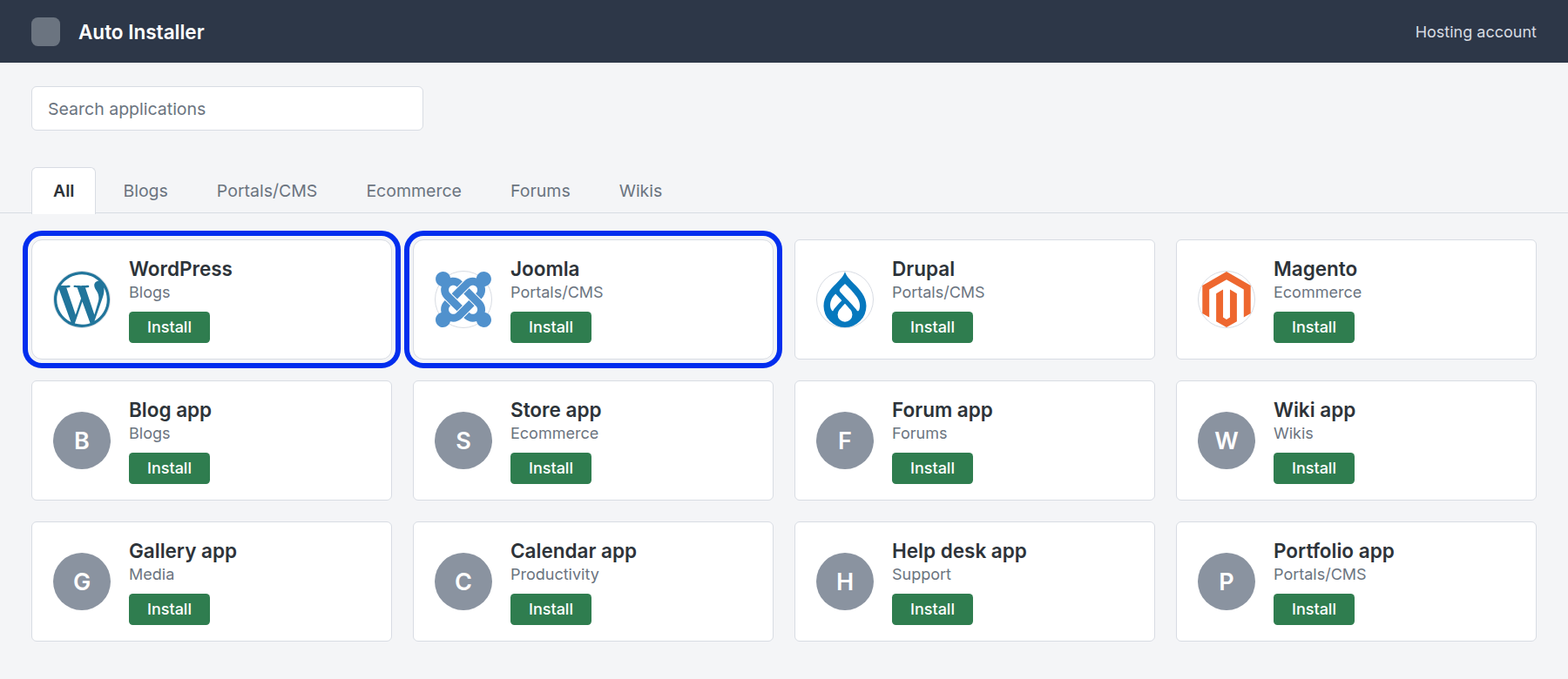
A one-click installer is the tool behind that one click. Softaculous is a well-known example, and it works with control panels such as cPanel, DirectAdmin, and Plesk. Its catalog lists WordPress and Joomla side by side, along with Drupal and Magento, so a host that offers it lets you install either platform from the same screen.
Choosing a host with both in its list keeps your options open. You can start with WordPress, the dependable route for most sites, and try Joomla later on the same hosting account if it starts to look like a better fit. Each host decides which apps it enables, so open the installer list before you buy. An example installer list looks like this, with WordPress and Joomla side by side.
WordPress has a huge support community and a large third-party ecosystem. Finding a Joomla professional can be harder and more expensive, and support windows for Joomla are fixed by version, so Joomla 4 reached end of life on 2025-10-14. Version 5 gets bug fixes through 2026-10-13 and security fixes through 2027-10-12. Version 6 gets bug fixes through 2028-10-17, and its security fixes run through 2029-10-16.
WordPress 7.1.2 is the current release, published 2026-09-22, and WordPress 7.0 was released on 2026-05-20. Joomla 6.0 shipped on 2025-10-14, with Joomla 5.4 as the long-term support release, and Joomla 6.1 is current, with 6.1.4 arriving on 2026-09-29.
W3Techs reports these shares on 2026-09-30. WordPress runs 58.7% of sites with a known CMS and 40.2% of all sites. Joomla runs 1.6% and 1.1%, Drupal runs 0.9%, and 31.5% of sites use no CMS at all.
Joomla 3 runs 52.0% of Joomla sites. Version 5 runs 20.6%, version 6 runs 8.9%, and version 4 runs 8.1%, so because Joomla 3 is end of life, you should check the version first if you inherit a Joomla site.
The Verdict
The choice comes down to your technical experience and what the site needs, and for most situations, WordPress is the better option. Match your situation to a pick:
- A first site: WordPress. The dashboard is approachable, and many hosts install it in one click.
- A blog or content site: WordPress, because it began as blogging software and separates posts from pages.
- A small business or marketing site: WordPress, with a much larger library of themes and plugins.
- Stores: WordPress with WooCommerce for the larger ecosystem, although Joomla stores exist in HikaShop and J2Commerce, both of which support Joomla 6.
- A large support community, or professionals to hire: WordPress.
- Built-in content types and user management, on a more complex site: Joomla, if you accept a steeper learning curve.
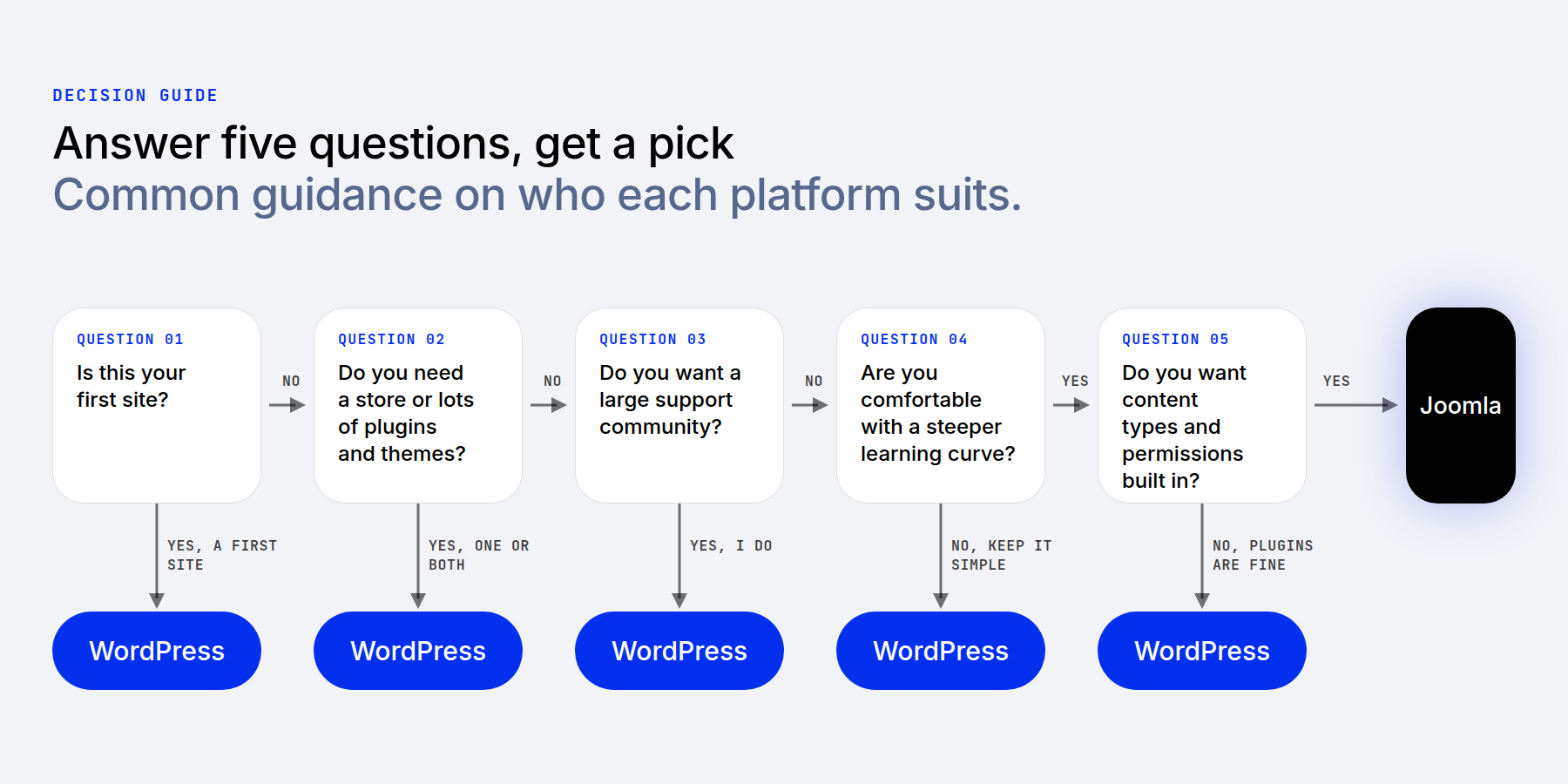
WordPress runs 58.7% of sites with a known CMS (W3Techs, 2026-09-30), and its theme and plugin library and support community are far larger. The flow below runs the same five questions.
If WordPress is your pick, Divi gives you a visual builder for pages and a Theme Builder for the rest of the site, and the Divi AI Agents can build and edit those layouts from a description, a screenshot, or a website URL. Our guide to getting started with Divi 5 covers the first build.
Joomla caters to experienced developers. It gives you control over the whole site, and it includes content types and user management that WordPress needs plugins for. For content creators who publish news or blog posts daily, WordPress fits better. For developer-run sites that need custom content structures and access controls, Joomla has a lot to offer.
More WordPress Comparisons
Before you make your final decision, you may want to see how WordPress stacks up against other platforms. We compared WordPress vs. everything else so you don’t have to. One of those comparisons is WordPress vs. Drupal, the third name in the market share figures above.
If you’re looking for plugins to extend WordPress, we recommend the following:
Frequently Asked Questions (FAQs)
Before we wrap up, let’s answer some of your most common questions about WordPress and Joomla. Did we miss one? Leave a question below, and we will respond!



Joomla and WordPress are all fantastic content management systems. Joomla come with many more built-in features than WordPress. However, WordPress beats them with its ease of use, huge global community, plugins and themes. I feel that most non-developer users would find it much easier to build with WordPress than Joomla.
Hi Keeton,
Nice comparison of two solid competitors in the same niche WordPress and Joomla. Yes, it’s true WordPress is easy to install, learn, and easy to use for technical and non-technical users. Whereas Joomla is a developer tool, and I guess it is mostly used by developers and agencies, not by individuals. Both are great in their way. I have not tried Joomla so far because WordPress has all the features that I need to run my blog.
Thank you,
I am working with both cms. Both are king on their way. Both are comfortable and different features. I feel thankful to myself I handle both cms easily…
I have been using both WordPress and Joomla for over 10 years and I would have to say that Joomla is much much better than WordPress. Once you learn the basics of Joomla, you will find it a lot easier to use. WordPress is overrated because for every small customization, you need to buy a plugin and that’s where most people make their money from. I find WordPress a lot more frustrating to use than Joomla.
I don’t know why I get so frustrated reading content like this. I get equally frustrated when I read comments from people who actually understand how powerful Joomla is and wonder, why aren’t they (or myself) writing articles like this, extolling Joomla’s virtues? Oh sh*t, it’s 10pm and I have to finish an app to allow a property development company’s purchasers a means of selecting their decor upgrades in an interface similar to building a car on Ford’s website. Also, it needs to be able to push completed decor selection agreements over to DocuSign via API, that will in turn update the decor system after signature completion, which will then trigger the system generate a purchase order and push it over to the Constructor’s cloud service via their API, so the trades know what to install in each suite… People who understand what can be possible, understand the limits of WordPress (or at least understand how much effort would go into getting WordPress to be able to do the things you can quickly do in Joomla or Drupal). I don’t mean to say that there isn’t a learning curve, but the reward to learning how it works drastically flips the pros and cons. I’ve walked into projects that had cost companies tens of thousands of dollars in manpower alone because some contractor promised them “you can do that in WordPress” and when they actually delved into the requirements and understood the business logic (and the business rules), found themselves overwhelmed because there was so much custom programming needed. Whereas, with just the Fabrik extension in Joomla, I can build a proof of concept in a couple of days and tweak business rules as the concept is reviewed on-the-fly. Off to work…
Years ago I had to learn Joomla to take over a website. I found it very confusing. I was used to editing HTML in the old-fashioned way. I have since built all my sites using WordPress. With all the plugins and builders it is super easy BUT I have had many tell me that WordPress is not that secure. I use some very robust security plugins that seem to do a good job of controlling who gets in. Anyone have thoughts on WordPress security?
A bit of an oddly timed comparison since Joomla 4 is (finally) getting released. That said what joomla does exponentially better than WP is granularity. You have to add a bunch of third party stuff to wordpress to do what Joomla does out of the box for user types/groups and access levels. This can make for very customizable sites that you as the admin can present to different types of users. For example showing types of ads to one user group and different ads to another. Showing different content to different types of users. This is also why the module implementation in joomla is out of the box, superior to widgets and overall page building in wordpress. It is extremely simple to put elements in a very specific place in joomla without any extra php or css or customizing of themes.
The other area where Joomla is far superior is themes/templates. Specifically in joomla you can assign different themes (templates in joomla syntax) to different pages or parts of your site.
All that said I have been using both Joomla and WP for years (going back to the beginning for both) but the primary benefit of WP today, is the availability of 3rd party developers both for plugins and support. A lot of joomla 3pd have jumped ship and some of the more important components and plugins for joomla are not supported well. For me, Joomla 4 is too little, too late and Joomla, since day one has been filled with infighting from the core developers and this has led to defections and sometimes misplace priorities in the releases. But as a CMS it is better conceived than WP and WP would be a better CMS with some Joomla influences in these specific areas that I mentioned.
I’m surprised that Joomla still looks like this…
I’m a sporadic website content (& developer) updater. I find WordPress and plugins to be a steep learning curve. I was looking for a ‘WYSIWYG’ style of plugin like a word processor I’m familiar with. But this isn’t reality yet for me. It took me an hour, or so, to add text to an existing text layer, which didn’t accept all of my text, because I didn’t know how to lengthen a text box. I finally did discover it, but I’m still facing a steep learning curve as a casual website developer. Plugins don’t seem to reduce the learning curve. I still need to learn how to format the text as it doesn’t allow formatting within the text box, like a word processor does. Still annoying, but keep smiling, as I may learn something yet.
Out of the box, Joomla is vastly more powerful. it’s multi langage, you can batch copy or move menus and articles, fine access rights and much more. But WordPress is de facto standard and end users want WordPress, than means developers have to work with WordPress, not Joomla and it shows: you get vastly more powerful plugins for WordPress and there is nothing like Divi on Joomla platform.
Dommage you compare joomla3 to wp 5.8
Joomla 4 IS comming in August and propose a reply to every argument
For me wp IS realy good for simplier site but if you need to create more powerfull site or intranet joomla IS realy better with full level Access (acl) multilingue and module(widget) assignation out of box in core
Neither are particularly intuitive designs. Both are captives of their history. It’s interesting that WordPress morphed into a CMS from blogging roots and became a more effective CMS than Joomla, which started life as a CMS.
WordPress is impressive at building pages and blogging. I still don’t care for the way media is handled in WordPress vs Joomla. I also like Joomla’s Access Control List that are built-in. Sometimes with WordPress I have added so many third party plugins that I worry how stable the site will be in the long run. I feel that Joomla has components built-in so I feel like they have worked out the bugs and the site will be stable longer.