

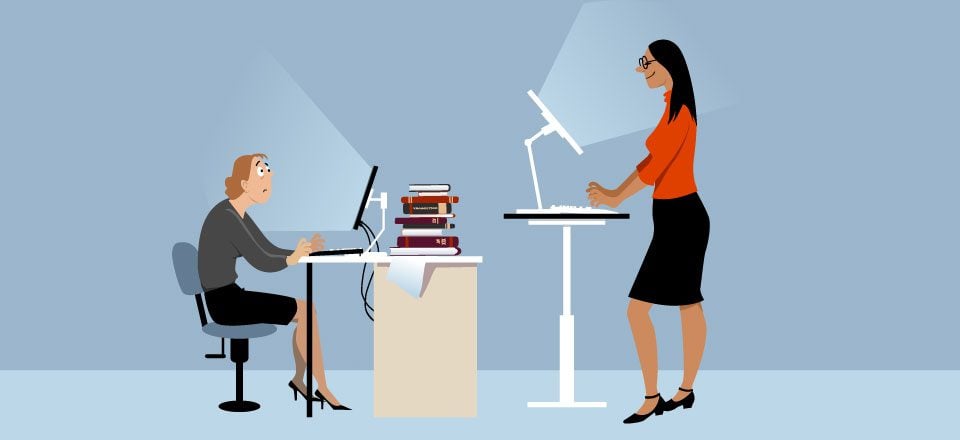
A couple of years ago, I made the executive decision to get rid of my couch. I replaced it with a set of chairs and matching ottomans, comfortable but not so tempting I’d plop down and work there all day.
This wasn’t quite the same as making a leap to a standing desk, but I knew that extra comfort meant less productivity. I was right. I work more often now and spend most of my work time in my office, not in front of the TV.
The Problem with Sitting…and Sitting…and Sitting
On its own, sitting isn’t inherently bad. The problem is sitting, and only sitting, for several hours per day. Your entire 8-hour shift should not be spent in a chair. Even those four-hour stretches before and after your lunch break could be too long.
This 2018 study found that sitting for several hours a day can increase the risk of type 2 diabetes, cardiovascular disease and early death.
While going for a run in the morning and staying active at night is great, that won’t counteract the effects of sitting for long stretches. That’s kind of like having a healthy meal for breakfast and dinner, and then eating a whole pizza for lunch. Yes, you’re making some good decisions, but the bad decision is still undeniably bad for your health.
6 Benefits of a Standing Desk
- Posture is naturally improved because you’re more aware of slouching. You may notice that your core feels tighter and more toned.
- You’ll engage in more physical activity. For example, you may end up walking more because you’re already standing.
- Your energy will increase. Standing can help with blood flow and keep you more alert. You may nod off or get groggy when sitting, but it’s less likely to happy when standing. That dreaded 3 p.m. slump could completely disappear.
- That study I mentioned above didn’t just measure the health effects of sitting, but also the job performance of people using “sit-stand desks.” They found that people who were able to stand part of the time had better job performance and engagement than those who only sat. Sit-standers also experienced less job fatigue and anxiety.
- Being at eye-level with passersby means it’s easier to chat or to take notice of something that’s going on.
- Multi-tasking is easier. I tried this at my counter and was able to multi-task without feeling too distracted. I was already standing, so making a cup of coffee while skimming email wasn’t a big interruption.
The Problem With Standing Desks
Standing is not a cure-all. Ergonomics expert Alan Hedge told Time that standing when working can be tiring and it can put a lot of strain on the circulatory system. It may also result in problematic posture, especially if you lean a lot. Here are a few more drawbacks of standing while working:
- Your legs and back may be numb or in pain, especially as you get used to using a standing desk. This can last for the first few weeks.
- If you don’t position yourself correctly, you could develop soreness in other areas. For example, when I stood at my kitchen counter, I had to wedge myself into the right angle the counter makes, then twist a little to see the computer. My lower back was aching within 45 minutes.
- The fact that it’s easy to multi-task also means it’s easy to get distracted. Consider saving standing for simple, automatic tasks, then sit when you need to focus distraction-free.
- You’re super exposed. Everyone in your office can see you (assuming you work with other people).
Standing while working isn’t for everyone, especially if you already have issues with your knees, legs or back, or with carpal tunnel. That doesn’t mean definitely don’t get a standing desk, but you should chat with your doctor first. For me, while I can see where a standing desk may help me with my back problems when it comes to posture and stretching, I also get a lot of benefits from taking an hour here or there to work on my laptop while leaning back on a heating pad.
How to Work at a Standing Desk
You can reduce the risks of using a standing desk if you do it the right way: maintain proper posture, limit strain on your body and adjust the keyboard, mouse and monitor to the best heights.
- Your monitor should be at eye-level (this is true if you’re sitting, too). Your arms should be parallel to the floor as you type. You should be far enough away so that if you were to extend your arms in front of you, you wouldn’t quite touch the monitor. If you have a laptop, you’ll want a separate monitor, and then either use the laptop as a keyboard or get an external keyboard.
- Put a supportive mat on the floor, like one chef’s use – the padding will decrease leg pain.
- Wear comfy, supportive shoes.
- If your legs start to get sore, go into a one-legged yoga pose, like a tree pose, for a couple minutes. Or you can put a raised object on the ground to rest your foot on. It’s fine to lean so long as it’s comfortable – you have to be off your bum, not a soldier standing at attention.
- March in place to increase blood flow. Bend, stretch and even do exercises like squats to keep your body loose and ward off stiffness.
How to Sit When You’re Not Standing
Posture is still important even if you’re sitting. According to Fast Company and medical director Mladen Golubic from the Cleveland Clinic Wellness Institute, slumping can make it hard to breathe deeply. Instead, sit straight without tensing; you have to sort of balance a straight spine and a strong core with being relaxed instead of tight. Basically: sit up straight, just not in that “the teacher’s going to scold me” way.
You can also get the benefits of standing by, you know, standing, no desk needed. Start by taking a five-minute standing/walking break for every hour of work. Set a reminder if you need to – my FitBit watch has a vibrating reminder to walk every hour. Working at home makes this easy because you can hop up from your desk as much as you need to without annoying coworkers.
Standing Desks to Consider Buying
When looking for the best standing desk for your purposes, these are the features you want to consider:
- Do you have to remain in the same position all the time or can you change the position to sit, stand, lean to one side, raise your leg, etc.?
- How large is your setup? What size desk will you need?
- What customization options do you need? Power strips, keyboard trays, holes for cables?
Also, check out the warranty, especially for advanced desks with electronic components.
Adapt Your Own Desk
If you want to adapt your current desk to a standing desk, try the Kangaroo Pro Junior, which starts at $399 before add-ons. It’s stable, has a decent size workspace and doesn’t require any other equipment, unless you want to add a detachable work surface. If you need more options, check out ErgoTron’s selection of standing desks. They have several types of desk mounts that lock sturdily to your desk, and adjustable arms can accommodate all sorts of setups, whether you have one or two monitors, a laptop, a keyboard, etc. Standing desk solutions from VIVO are also worth checking out – they have monitor mounts, desk risers and frames to create your perfect setup.
Stand-Alone Standing Desks
The GeekDesk (starting at $749) platform goes up and down by pushing a button, and the Max version (starting at $949) lets you set height presets. The Uplift V2 Bamboo Standing Desk ($495) also has programmable heights, and you can switch between four stored adjustments.
If you want to save money, the Devaise Adjustable Height Standing Desk ($229.99) lets you adjust the height via crank instead of electronically. There’s also the Muv Stand-Up Adjustable Height Desk ($390), which has three surfaces plus a keyboard shelf.
Wrapping Up
There’s no single posture that’s best, and standing desks are beneficial because you can easily switch positions. Standing for eight hours isn’t much better than sitting for eight hours, especially considering the strain it will put on your body. Shift between a variety of postures throughout the day. Standing should be one of the postures, and sitting can definitely remain part of the mix.
Standing is a start if you want to raise your energy levels. Find out even more ways to get motivated right this second.







You know I have been considering purchasing an electrically powered, adjustable desk so I can spend at least half my day standing, the other half sitting. Best of both worlds.
Ikea have a few options for these type of desks. You’ve reminded me this is something I must sort out and do!
Thank you Lindsay 🙂
Thanks Lindsay! I have been using a standing/sitting desk that I purchased at IKEA two years ago and I love it! It’s not electric but easy to crank and can adjust to any height you wish easily! It is sturdy, and they offer more than one size of desktop to suit your needs. I really love it!
Thanks for your comment Jackie, happy to hear you love your standing desk!
Excellent! You’re welcome, and I’d love to hear out it turns out!
I used a standing desk for a year and switched back to a sitting desk. I’m so relieved that is over. I kind of liked the standing desk for short periods, but even with a really good cushioned mat my legs would be killing me at the end of the day. I found myself avoiding working. I found a lot of other reviews from people who gave up after awhile. I’m fortunate that I work from a home studio, so what I do is regularly take breaks to go for a walk, do housework, garden, etc. If you work in an office where you can’t do that – I really recommend having a standing/sitting desk so you can alternate.
Hey Leslie – I do the same thing – I work from home and I’m up and down so much that a standing desk doesn’t make too much sense for me. I do sometimes stand to do easier work, and I can see how it can be straining on your back and legs!