

The Divi 5 Visual Builder is highly customizable. You can open and close panels, dock them to either side of the screen, float them over the canvas, resize them, group them into tabs, choose which top-bar icons appear, and switch between light and dark modes.
That flexibility is useful, but it also creates a small problem: the setup that works best for one task is not always the setup you want for another. A layout-heavy build might need the Layers and Inspector panels open. A writing session might need a cleaner canvas. A smaller screen might need fewer panels competing for space.
Divi 5 Workspaces solve that by letting you save complete builder setups and switch between them whenever you need. Instead of rearranging the interface by hand every time your task changes, you can save one workspace for your default build flow, another for content editing, another for responsive checks, and another for focused work.
In this post, we’ll look at what Workspaces save, how they’re organized, how to create and manage your own, how to switch between them with the Command Center, and which workspace setups are worth trying on a real Divi 5 project.
- 1 What Are Workspaces In Divi 5?
- 2 What A Workspace Saves
- 3 Why Workspaces Matter
- 4 The Three Types Of Workspaces
- 5 How To Create A New Workspace
- 6 How To Set A Default Workspace
- 7 How To Manage Your Workspaces
- 8 Switching Workspaces With The Command Center
- 9 Practical Workspace Setups To Try
- 10 Tips For Using Workspaces Well
- 11 Make The Divi 5 Builder Your Own
What Are Workspaces In Divi 5?
A workspace is a saved version of your Visual Builder setup. It remembers how your builder interface is arranged and which preferences shape the way it behaves. Once you save that setup, you can return to it later with one click or through the Command Center.
A workspace only changes the builder interface. It does not change the content, design, or settings on the page itself. Your modules, rows, sections, presets, and layout stay exactly as they are. Only the building environment changes.
You’ll find the Workspaces icon in the left sidebar.
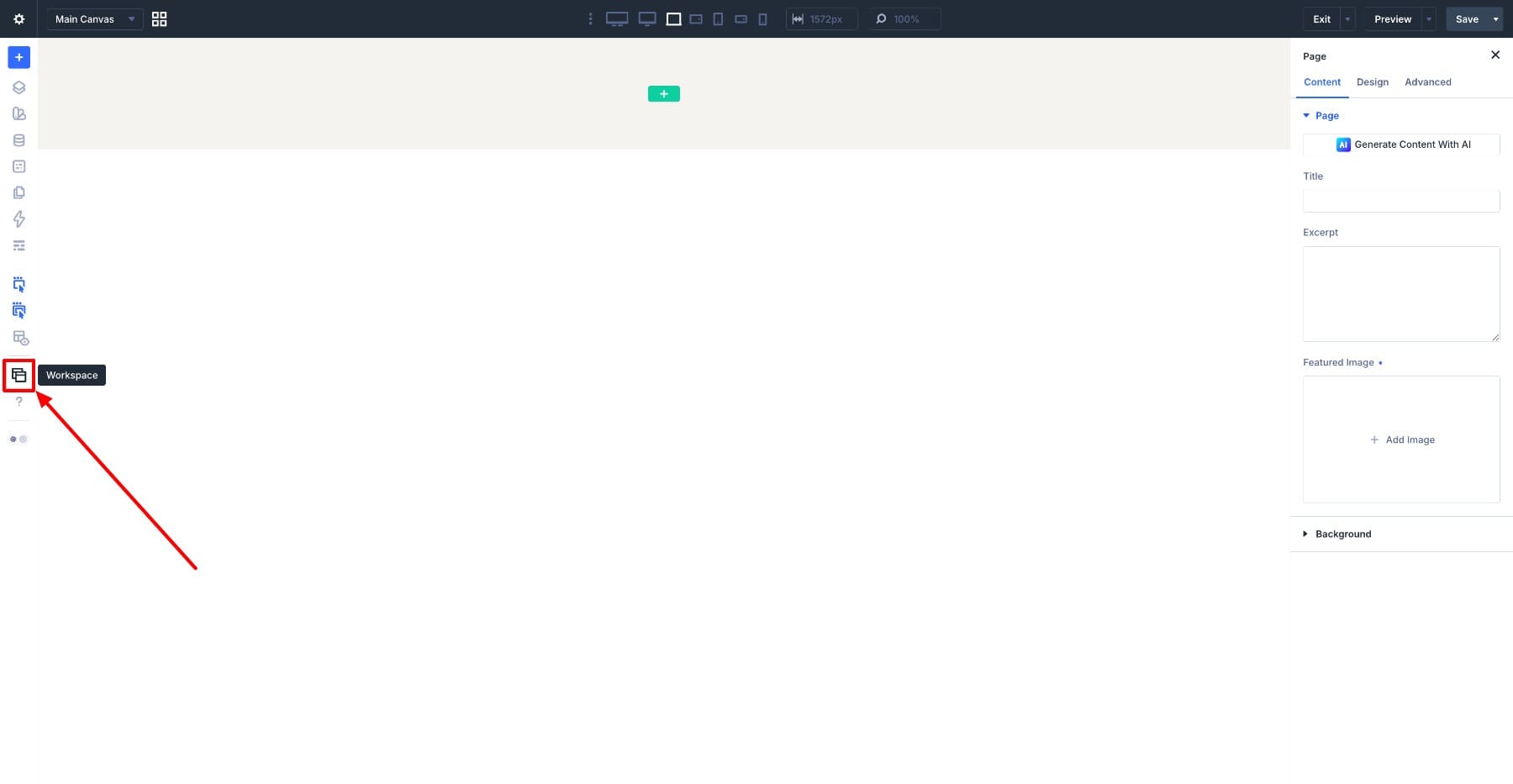
Creating one is simple. Arrange the builder the way you like it, open the Workspace panel, and save that setup as a new workspace.
You are not limited to one workspace. You can create multiple setups for different jobs, then move between them as you build.
One workspace might keep the canvas clean for writing. Another might keep Layers, Inspector, and the Settings panel available for complex layout work. Another might open directly into a responsive view so you can check tablet or phone layouts faster.
The goal is not to create a different workspace for every tiny preference. The goal is to save the builder setups you actually return to.
What A Workspace Saves
A workspace saves two broad categories of information: your interface layout and your builder preferences. Together, those settings define how the Visual Builder looks and feels while you work.
Interface Layout
The first thing a workspace saves is your panel arrangement. That includes:
- Which panels are open or closed
- Where panels are docked
- Whether panels are floating or attached to a sidebar
- Panel size and position
- Sidebar width
- Tabbed panel groups
- Active builder view, such as Wireframe or responsive views

This is the part you notice immediately. Switch workspaces, and the builder rearranges itself around the task you saved it for.
Workspace Settings
A workspace also saves builder preferences from the Workspace Settings panel. These settings control how the builder behaves, how much interface chrome appears, and what kind of starting point you see when building.
Here are the main settings covered in the workspace panel:
- Interface Mode: Switches the builder between Light and Dark mode.
- Color Scheme: Sets the builder accent color, including options such as Blue, Purple, Green, Red, and Orange.
- Enable Admin Bar: Shows or hides the WordPress admin bar while you work.
- Page Bar Icons: Controls which action icons appear in the top bar, such as undo, redo, history, import/export, clear layout, and add to library.
- Builder Default View Mode: Sets the view the builder opens in, such as desktop, tablet, phone, or Wireframe View.
- History State Interval: Controls how often the builder records undo states, from After Every Action to wider intervals such as every 10th, 20th, 30th, or 40th action.
- Settings Modal Default Position: Sets where settings panels open, such as left sidebar, right sidebar, or floating over the canvas.
- Page Creation Flow: Controls what appears when creating a new page, such as Give Me A Choice, Build From Scratch, Load Premade Layout, or Build With AI.
- Show Disabled Modules At 50% Opacity: Makes hidden elements easier to spot while editing.
- Group Settings Into Closed Toggles: Keeps option groups collapsed when opening module settings.
- Add Placeholder Content To New Modules: Adds sample content to new modules so you can see their structure before replacing it.
- Speed Up The Builder With Prerendering: Preloads builder pages in the background for faster navigation.
- Show Theme Builder Layouts: Controls whether headers, footers, and other Theme Builder areas appear while editing a page.
That is why Workspaces are more than saved panel layouts. They can change the whole building environment in one move.
If a top-bar icon you expect is missing, check Workspace Settings first. It may simply be turned off in the active workspace.
Why Workspaces Matter
Before Workspaces, customizing the builder was still possible, but those adjustments were tied to the moment. You arranged panels, opened the tools you needed, cleared the ones you did not, and then did it again later when the task changed. Workspaces turn that setup process into something reusable.
You arrange the builder once, save it, and return to that arrangement whenever it fits the job. When you move from layout design to writing, or from desktop design to responsive checking, the interface can change with the task instead of staying in whatever state you last left it.
That matters most during long sessions. A cleaner workspace means fewer panels to look past. A power-user workspace means the tools you reach for most are already open. A responsive workspace means you start closer to the breakpoint you want to review.
Workspaces are also personal. Every user on the site can create their own collection, so your saved builder setup does not need to match anyone else’s. A designer, writer, developer, and client can each use a different interface without changing the page content or forcing a shared panel layout on the rest of the team.
The Three Types Of Workspaces
When you open the Active Workspace menu, workspaces are grouped by where they come from and who they belong to.
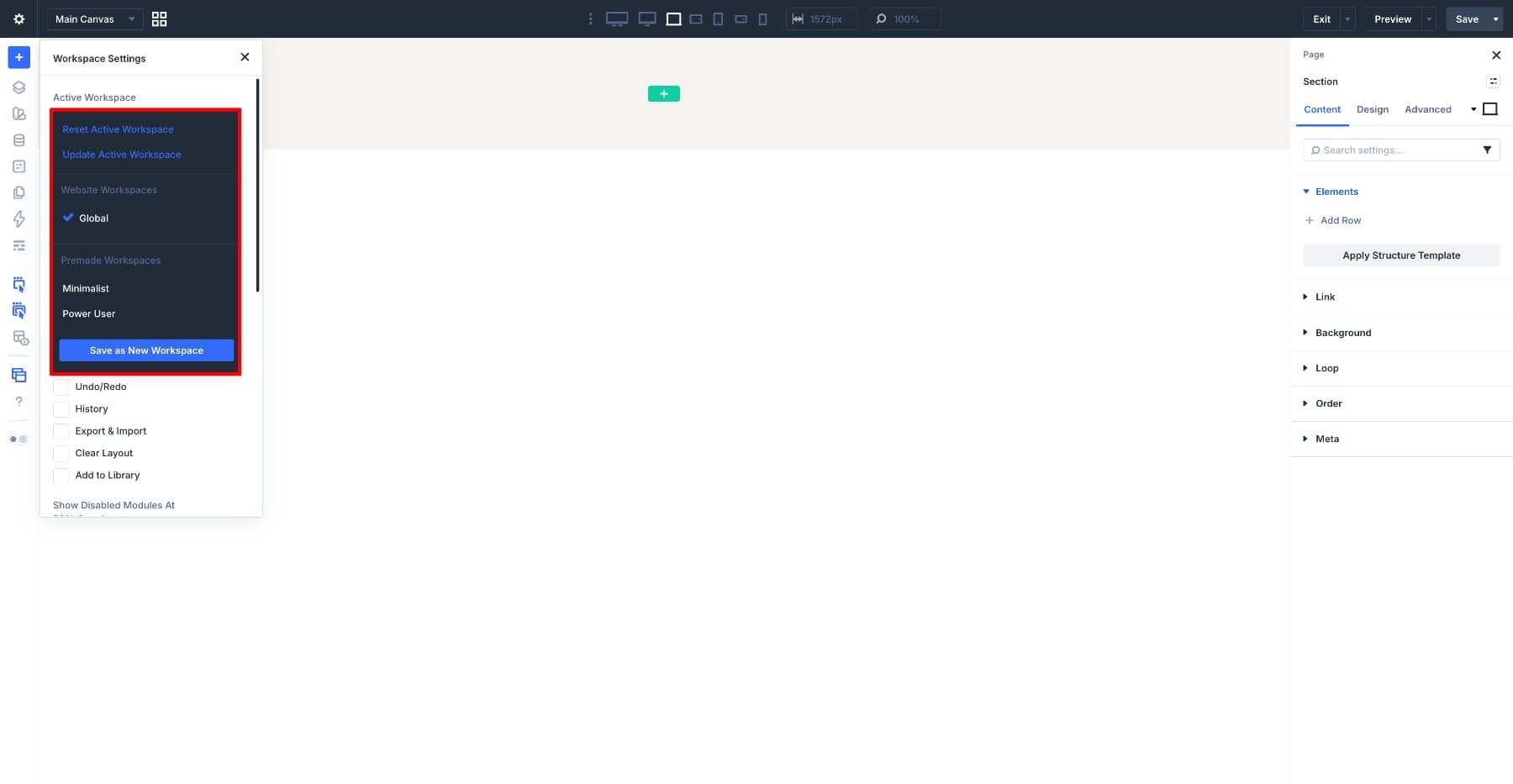
Website Workspaces
Website Workspaces belong to the site. This group includes Global, the shared workspace that acts as the baseline builder setup. It is the setup users see before they create or choose a personal workspace.
That makes Global useful as a common reference point. If a team needs screenshots, documentation, or a shared starting layout, the Global workspace gives everyone a familiar baseline before they branch into personal setups.
Your Workspaces
Your Workspaces are the ones you create and save for your own WordPress user account. Nobody else on the site has to use them, and your workspace choices do not change how someone else’s builder is arranged. This is where your personal default, content-editing setup, responsive setup, or focus setup will live.
Premade Workspaces
Premade Workspaces are built into Divi 5. The two premade options are Power User and Minimalist. They give you ready-made starting points when you do not want to build a workspace from scratch.
Premade Workspaces are best treated as foundations. Activate one, adjust the builder to match your workflow, then save the adjusted setup as a new workspace of your own.
How To Create A New Workspace
Creating a workspace only takes a few minutes. The main work is deciding what kind of setup you want to save. Open your page in the Visual Builder. The builder loads your current default workspace. If you have not chosen one yet, that will usually be Global.
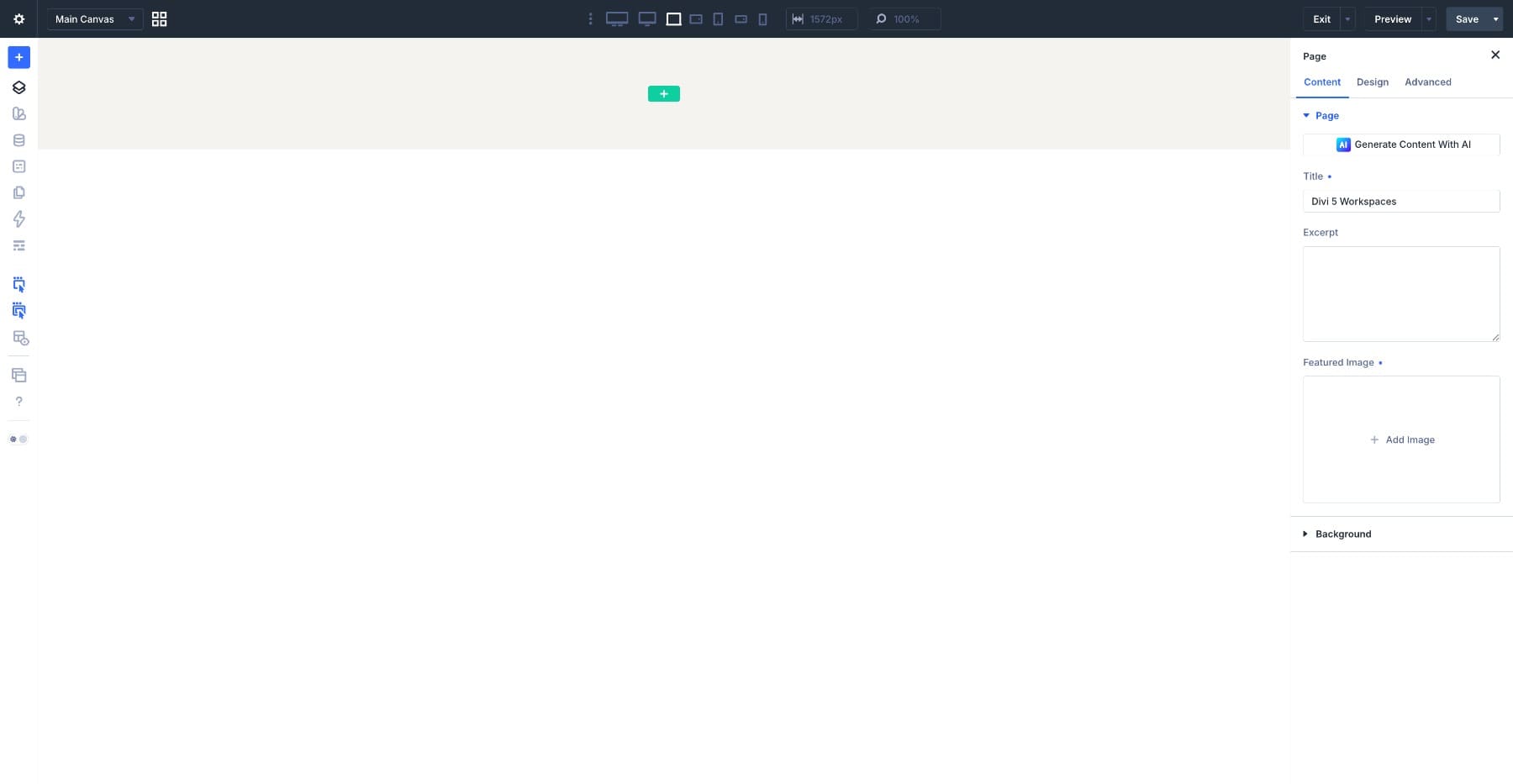
Arrange your panels the way you want to work. Open the panels you use often, such as Layers or Inspector. Dock panels to the left or right, float them over the canvas, resize them, or combine them into tabbed groups.
Next, open Workspace Settings by clicking the Workspaces icon in the left sidebar.
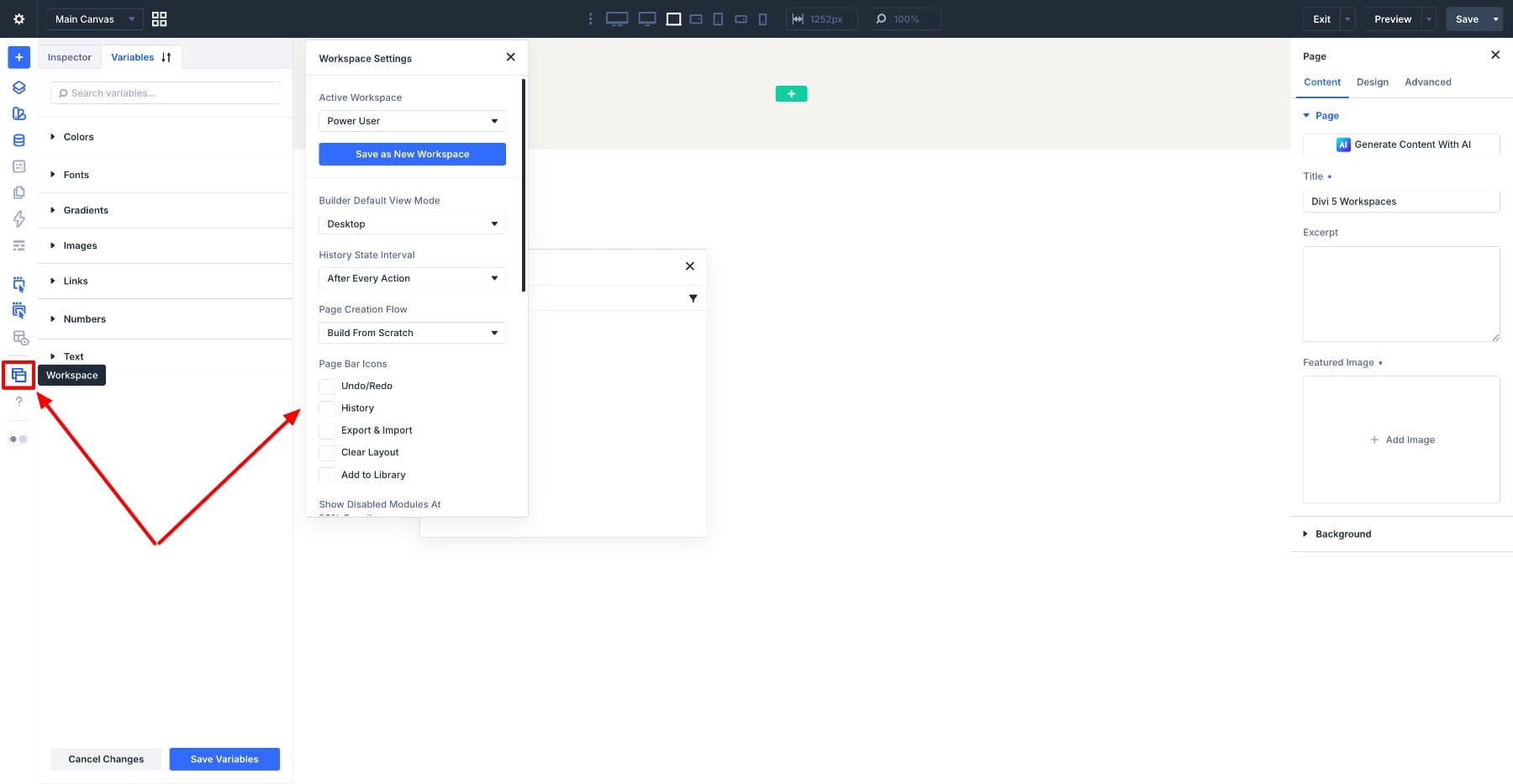
Set the preferences that should belong to this workspace. Choose the interface mode, color scheme, admin bar visibility, top-bar icons, default view mode, settings modal position, and other builder preferences.
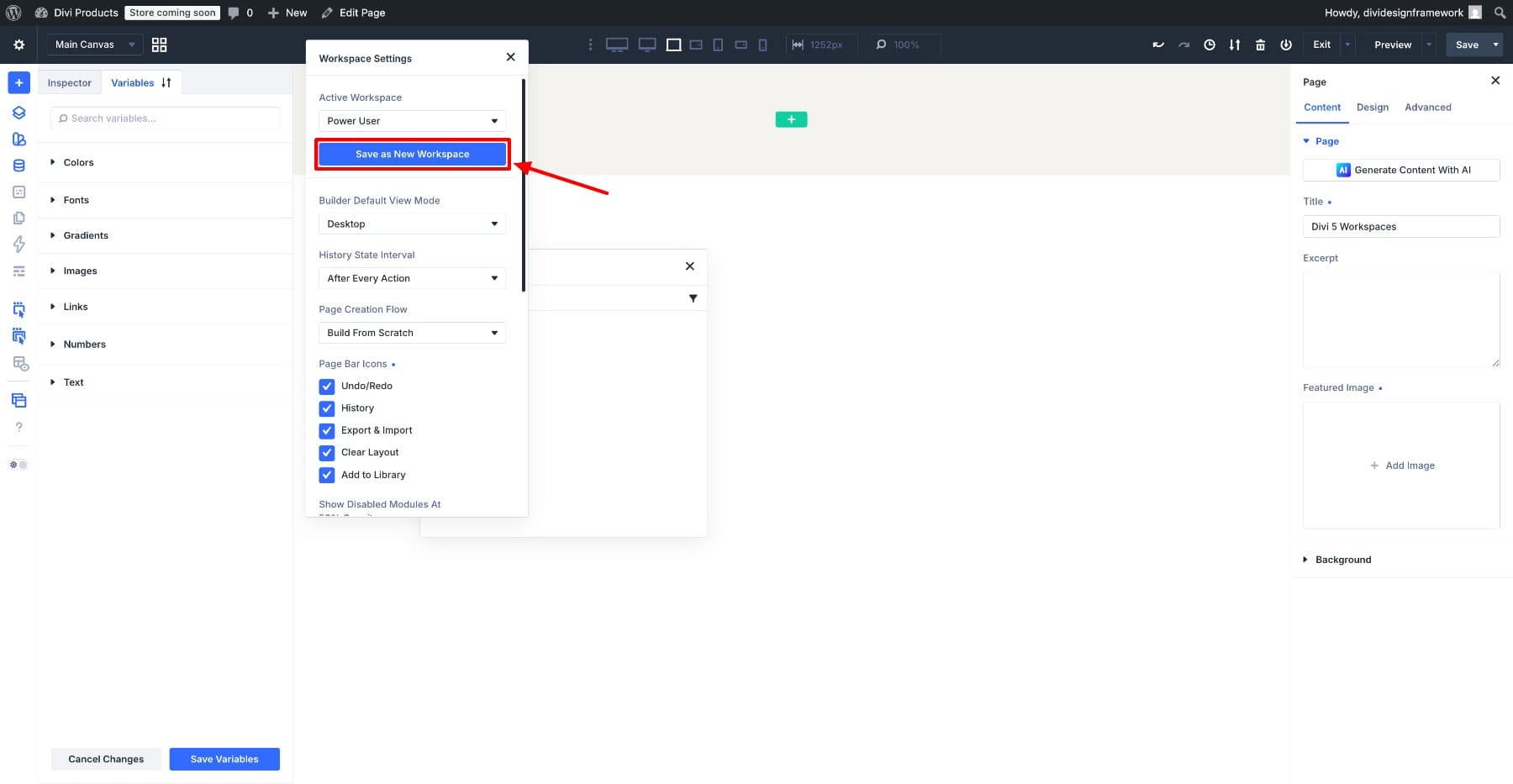
When the builder looks and behaves the way you want, click Save as New Workspace.
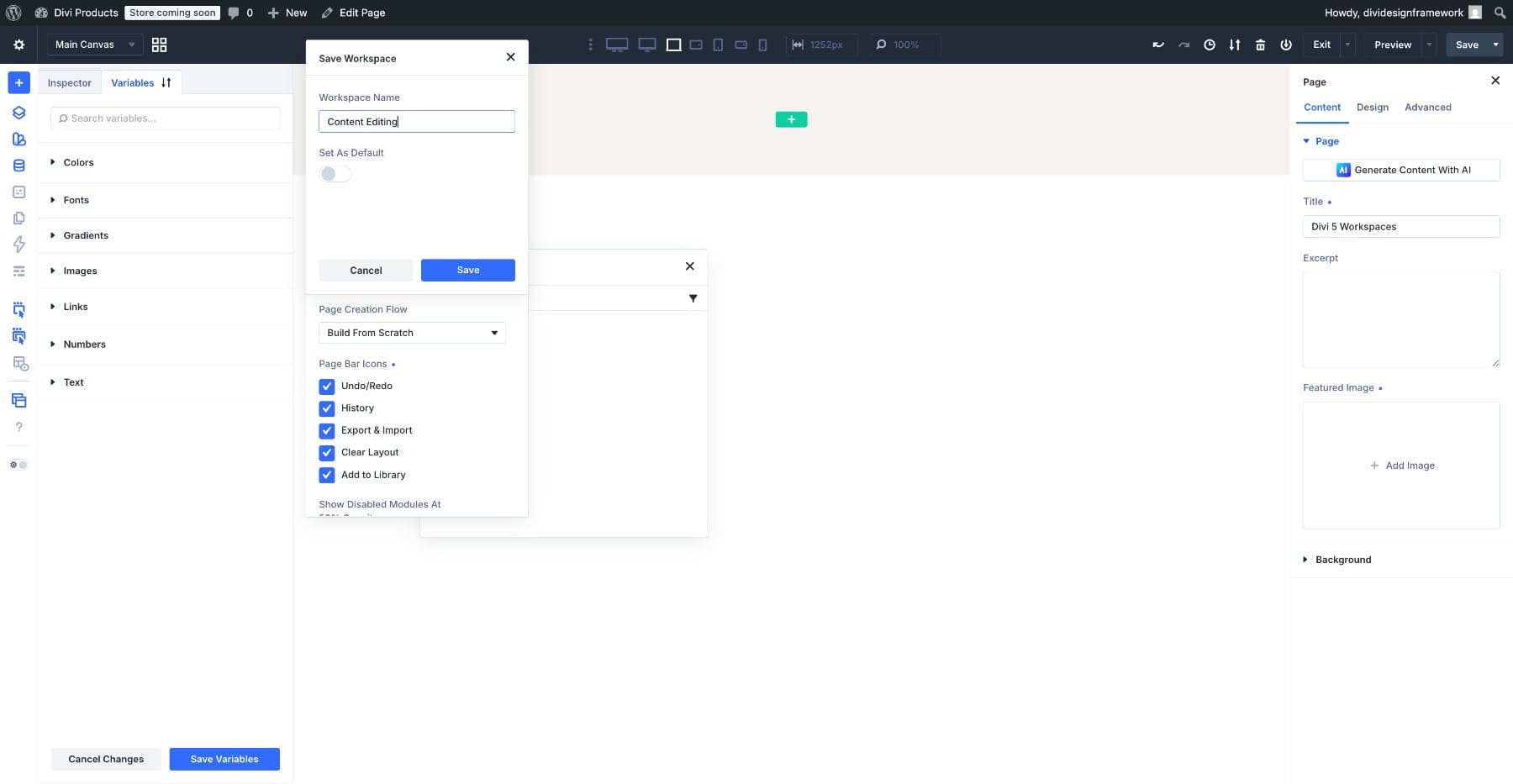
Give the workspace a clear name in the Save Workspace modal. Use names based on the job or screen size, such as Default Build, Content Editing, Responsive Review, Widescreen, or Focus Mode.
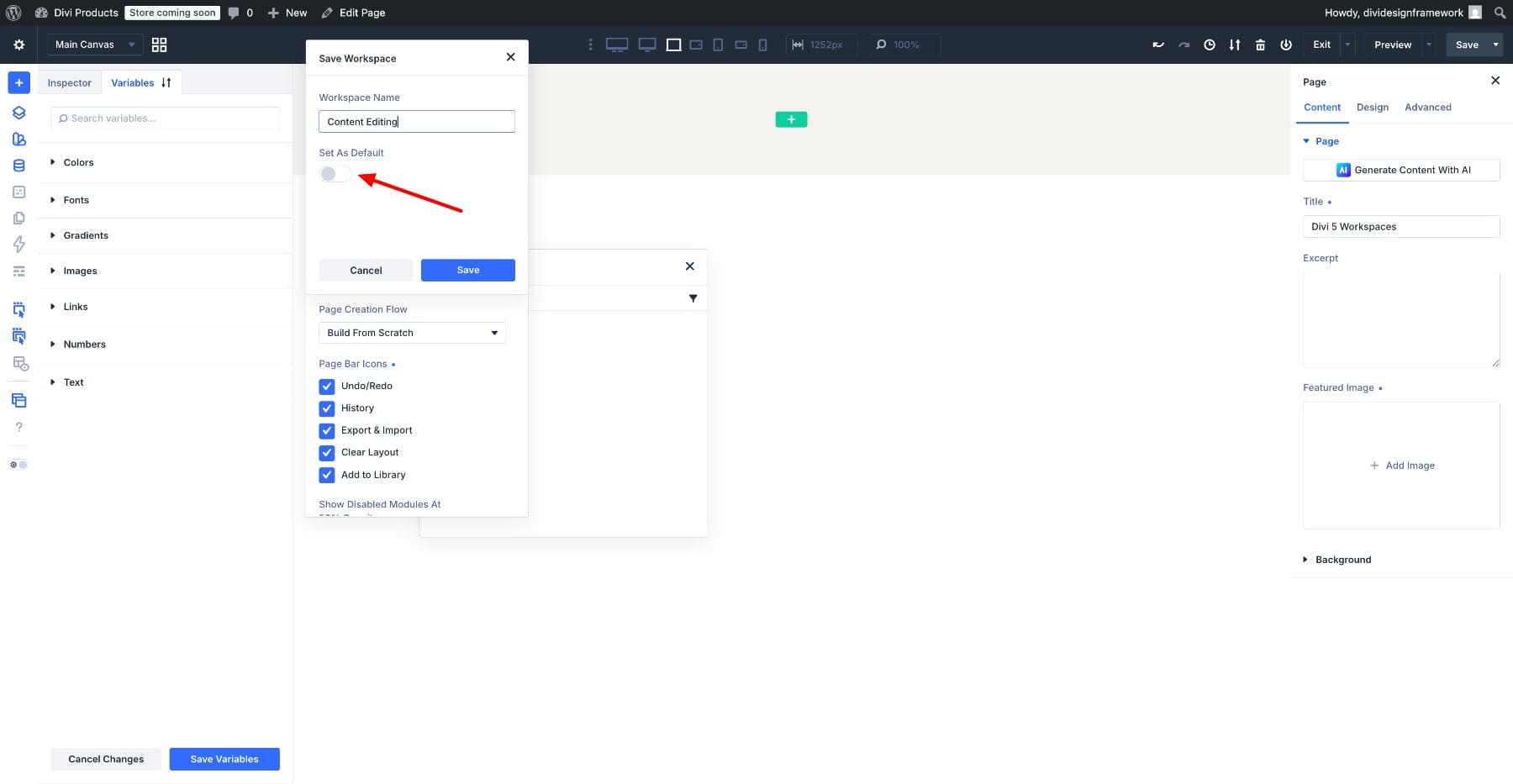
Enable Set as Default if you want this workspace to load automatically when you open the builder.
Click Save. Your new workspace appears under Your Workspaces.
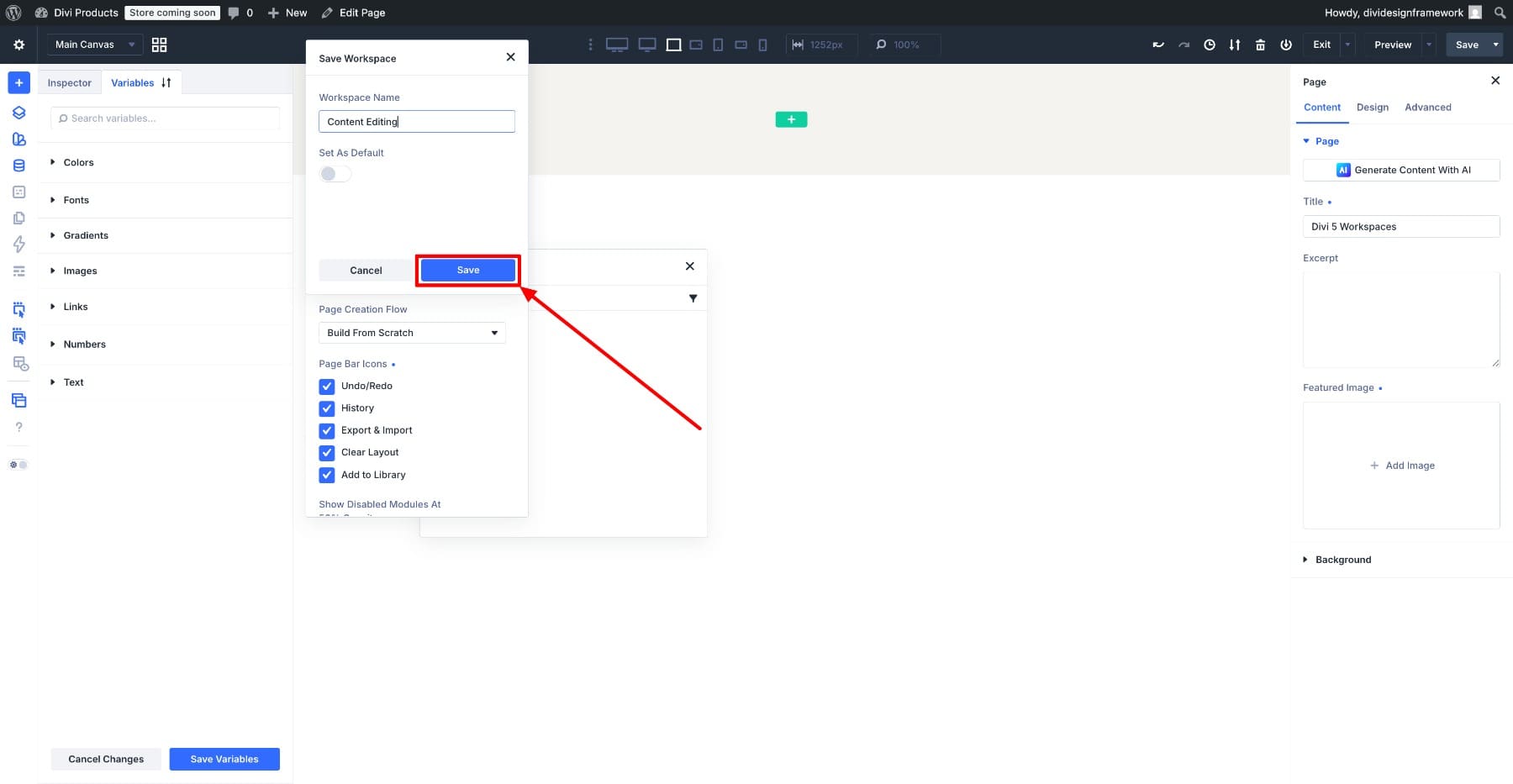
To test it, switch to another workspace and then switch back. Your panels and preferences should return to the saved arrangement.
How To Set A Default Workspace
Your default workspace is the setup the builder loads when you open a page. If you save a new workspace and want to use it most of the time, enable Set as Default while saving it.
You can also set an existing workspace as your default later. Open the Active Workspace menu, find the workspace you want, and mark it as the default using the star icon.
Once set, your default holds across sessions. Refresh the builder or come back later, and Divi opens into that workspace with your saved panels and preferences restored.
Your personal default applies to your user account. The Global workspace remains the shared baseline for users who have not chosen their own default.
How To Manage Your Workspaces
Everything you save lives in the workspace panel. Open it, and you can activate, update, duplicate, rename, reset, or delete workspaces from one place.
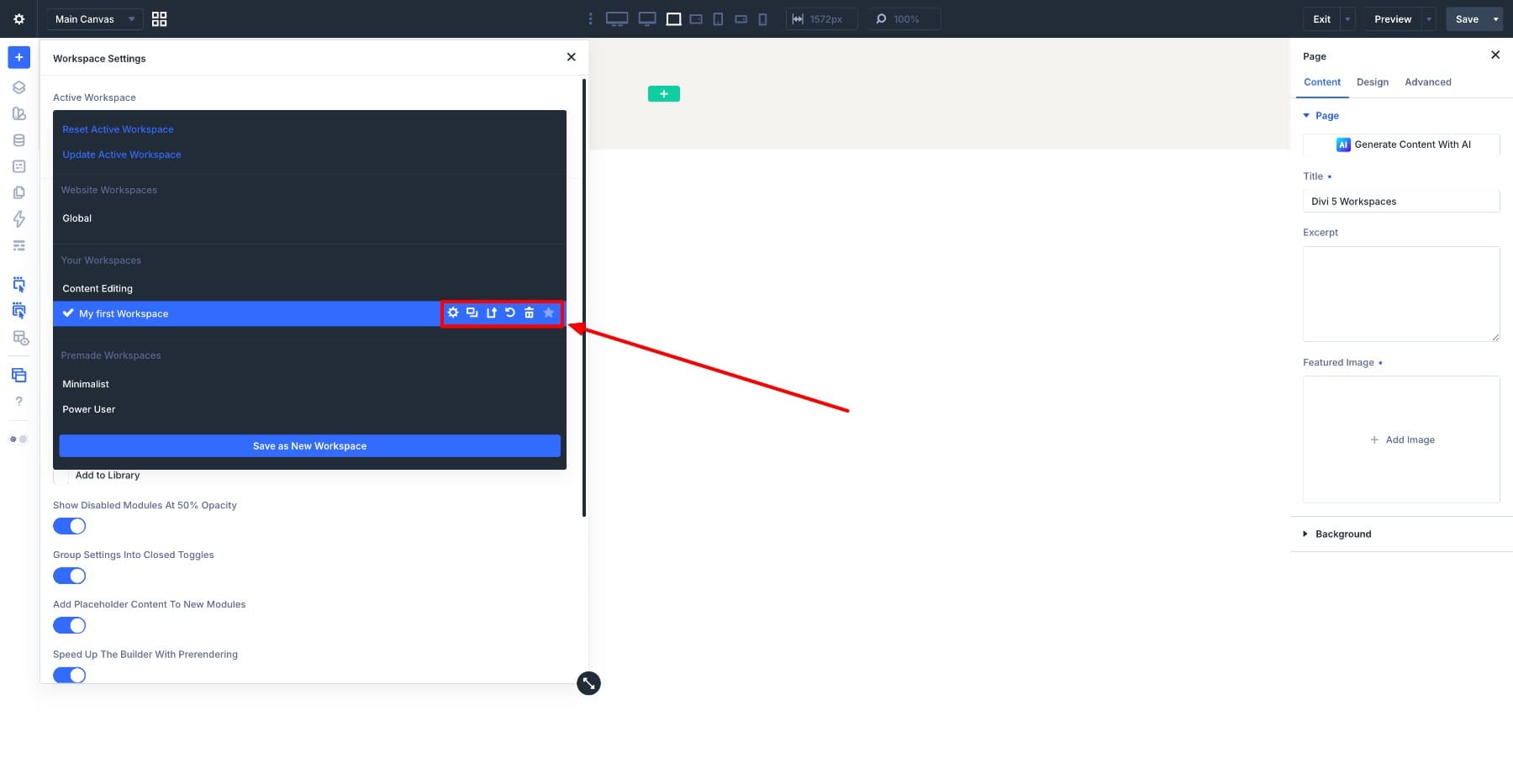
Here is what each action does:
- Duplicate: Creates a copy of a workspace. Use this when you want a new setup that starts from an existing one.
- Delete: Removes a workspace you no longer use.
- Rename: Changes the workspace name.
- Set as Default: Makes the workspace the one the builder opens automatically.
- Reset: Restores the workspace to its saved state and discards unsaved interface changes.
- Update: Saves the current builder arrangement into that workspace.
The two actions to watch closely are Update and Reset. Update writes your current builder setup into the active workspace. If you moved a panel, changed the mode, or adjusted visible icons and want to keep those changes, update the workspace. Reset does the opposite. It drops recent changes and brings the workspace back to its last saved version.
For example, say you move the Inspector panel to a new position and decide it works better there. Run Update, and that new position becomes part of the workspace. Switch away and come back later, and the Inspector returns to the updated position.
If you experiment with a setup and decide you do not like it, use Reset instead.
Switching Workspaces With The Command Center
The workspace panel is easy to use, but the Command Center is the faster option once you know the commands. Press Cmd+K on Mac or Ctrl+K on Windows to open the Command Center.
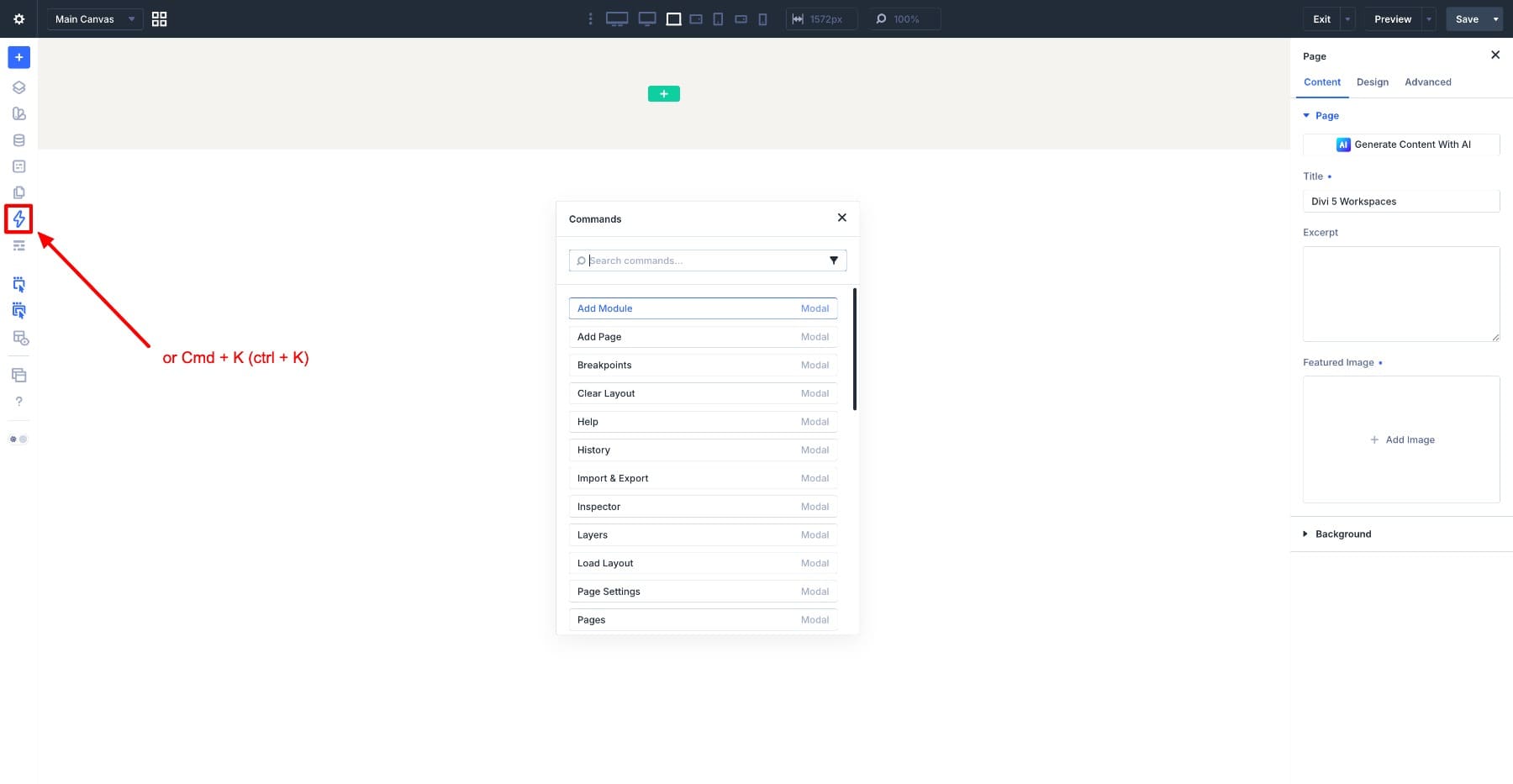
Divi 5 adds workspace commands so you can save, switch, update, and reset workspaces without digging through panels.
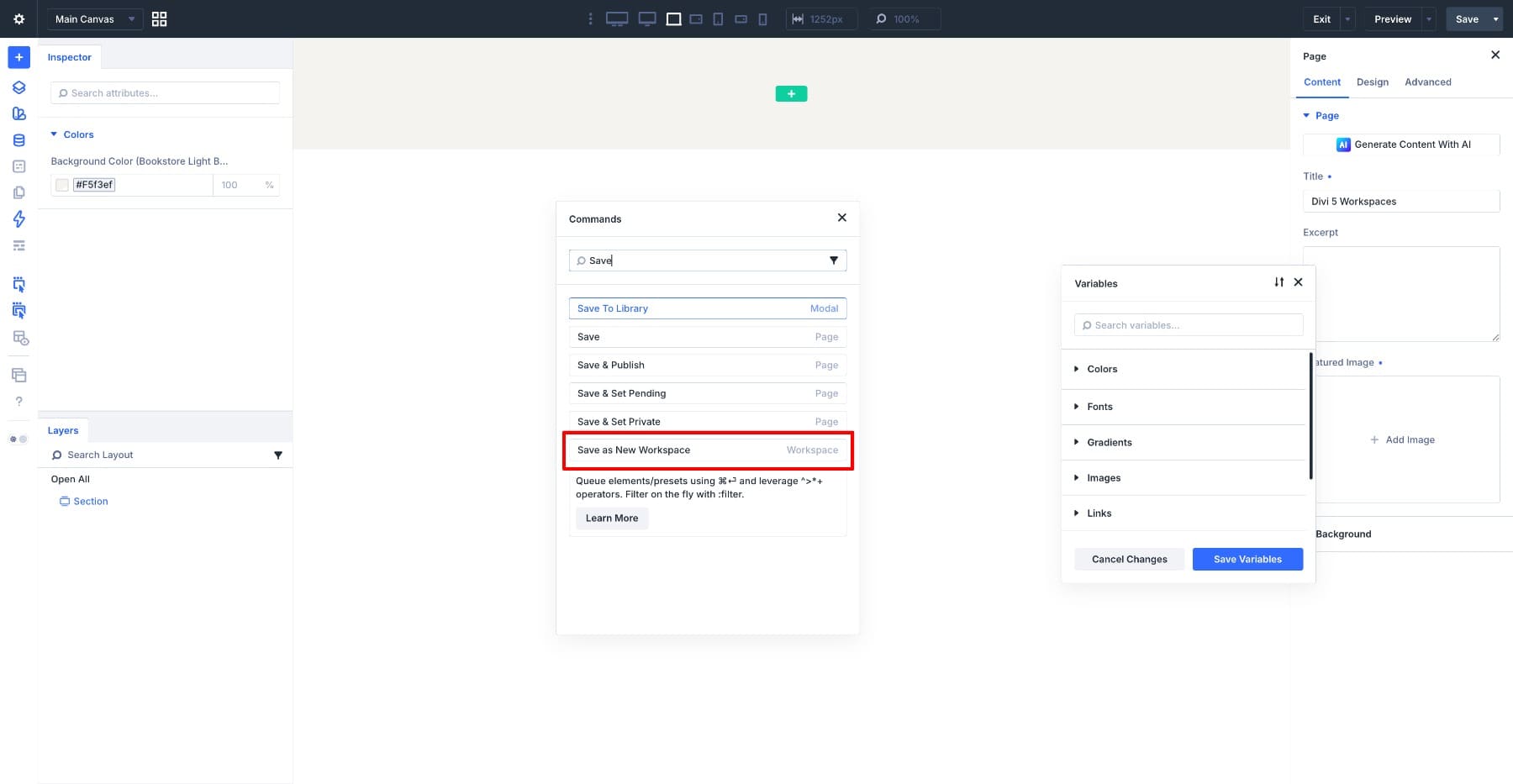
The main workspace commands are:
- Save as New Workspace: Captures the current builder setup and saves it as a new workspace.
- Switch Workspace: Lets you choose a saved workspace and switch to it quickly.
- Update Active Workspace: Saves the current builder setup into the active workspace.
- Reset Active Workspace: Restores the active workspace to its saved state.
If you just arranged the builder and want to keep that setup, open the Command Center, run Save as New Workspace, and name it. If you want to switch setups, open the Command Center, type the workspace name or use the switch command, and press enter. The builder rearranges itself around the selected workspace.
The upkeep commands are useful during real work. If you adjust your current setup and want to keep it, run Update Active Workspace. If you changed too much and want the saved version back, run Reset Active Workspace.
Once those commands become familiar, switching workspaces starts to feel like part of the build flow rather than a separate setup task.
Practical Workspace Setups To Try
Workspaces become more useful when they are tied to real tasks. Here are a few setups worth creating.
1. Default Build Workspace
Start with one solid default workspace. This should match how you usually build. If you spend most of your time moving through page structure, keep Layers and Inspector available. If you rely on the Command Center, keep the interface cleaner and let keyboard commands handle more of the work.
Nick’s walkthrough shows this idea well. His setup keeps useful navigation panels open, keeps the builder focused, and removes top-bar icons he does not need because he handles those actions through right-click menus and keyboard shortcuts.
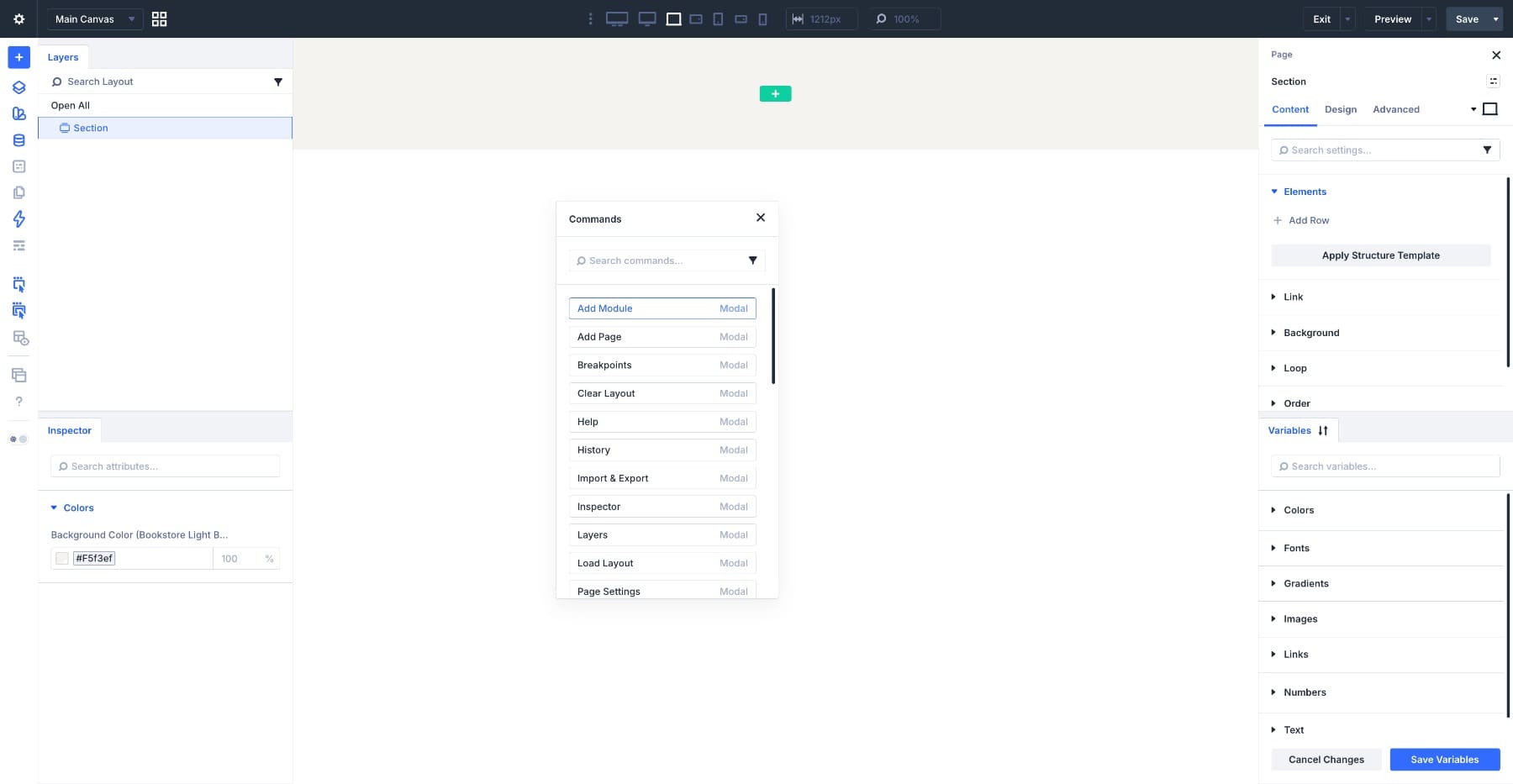
Use this as your baseline. Once your default feels right, duplicate it and create more specific variations.
2. Content Editing Workspace
A content-editing workspace is built for writing and text edits. Use Light mode if it feels easier for reading. Hide Theme Builder layouts if headers and footers are distracting. Turn off placeholder content if you want new modules to stay empty until real copy is added.
Keep only the panels a writer or editor needs, and give most of the room back to the canvas.
This setup works well when you are polishing copy, replacing placeholder text, or reviewing a page with a client.
3. Responsive Review Workspace
A responsive-review workspace is built for checking structure and breakpoints. Set Builder Default View Mode to a responsive view if you often start reviews on tablet or phone. Or save the workspace while the builder is already sitting in the breakpoint you check most often.
You can also use Wireframe View when structure matters more than visual styling.
This saves time when you are moving through a site and checking whether sections, rows, and modules stack correctly.
4. Client Editing Workspace
A client editing workspace keeps the builder approachable. Reduce visible tools, hide panels the client does not need, and keep the canvas front and center. The goal is to make light edits feel less intimidating.
There is one important limit: a workspace changes how the builder looks, not what someone is allowed to do. If you need to control permissions, use Divi’s role-management tools alongside the workspace. The workspace shapes the view. Permissions set the boundaries.
5. Focus Workspace
A focus workspace is for long, uninterrupted building sessions. Start from the Minimalist premade workspace, switch to dark mode if you prefer a lower-glare canvas, and bring in only the one or two panels you need most.
This setup is useful when you already know what you are building and want fewer interface elements competing for attention.
Tips For Using Workspaces Well
Once you start saving workspaces, a few habits will keep your collection useful.
- Build one strong default first. Get your main setup right before creating several variations.
- Start from a premade workspace when useful. Power User and Minimalist are good foundations when you do not want to start from scratch.
- Name workspaces by task. Names like Content Editing, Responsive Review, and Focus Mode are easier to scan than vague labels.
- Design around your screen size. A setup that feels perfect on a large monitor may feel crowded on a laptop.
- Update before you refresh. If you changed a workspace and want to keep it, run Update Active Workspace before reloading the builder.
- Delete setups you no longer use. A short list of useful workspaces is better than a long list of almost-identical ones.
- Keep a shared reference for teams. Since each user can customize their own builder, a shared Global workspace can make documentation and screenshots easier to follow.
Workspaces should reduce friction. If your list becomes another thing to manage, simplify it.
Make The Divi 5 Builder Your Own
Workspaces turn the Divi 5 builder interface into something you can shape around your workflow. Instead of rebuilding your setup at the start of each session, you can save the way you like to work and return to it instantly. Create a default build workspace, add a few task-specific setups, and switch between them when the job changes.
The best place to start is a real project. Open a page you are already working on, arrange the panels the way you wish the builder always opened, set your preferences, and save it as your default workspace.
From there, the next workspace usually becomes obvious. Maybe you need a cleaner writing setup, a responsive review setup, or a focused layout setup for long sessions. Build only what you will use, keep the collection practical, and let the builder adapt to the way you work.





Leave A Reply